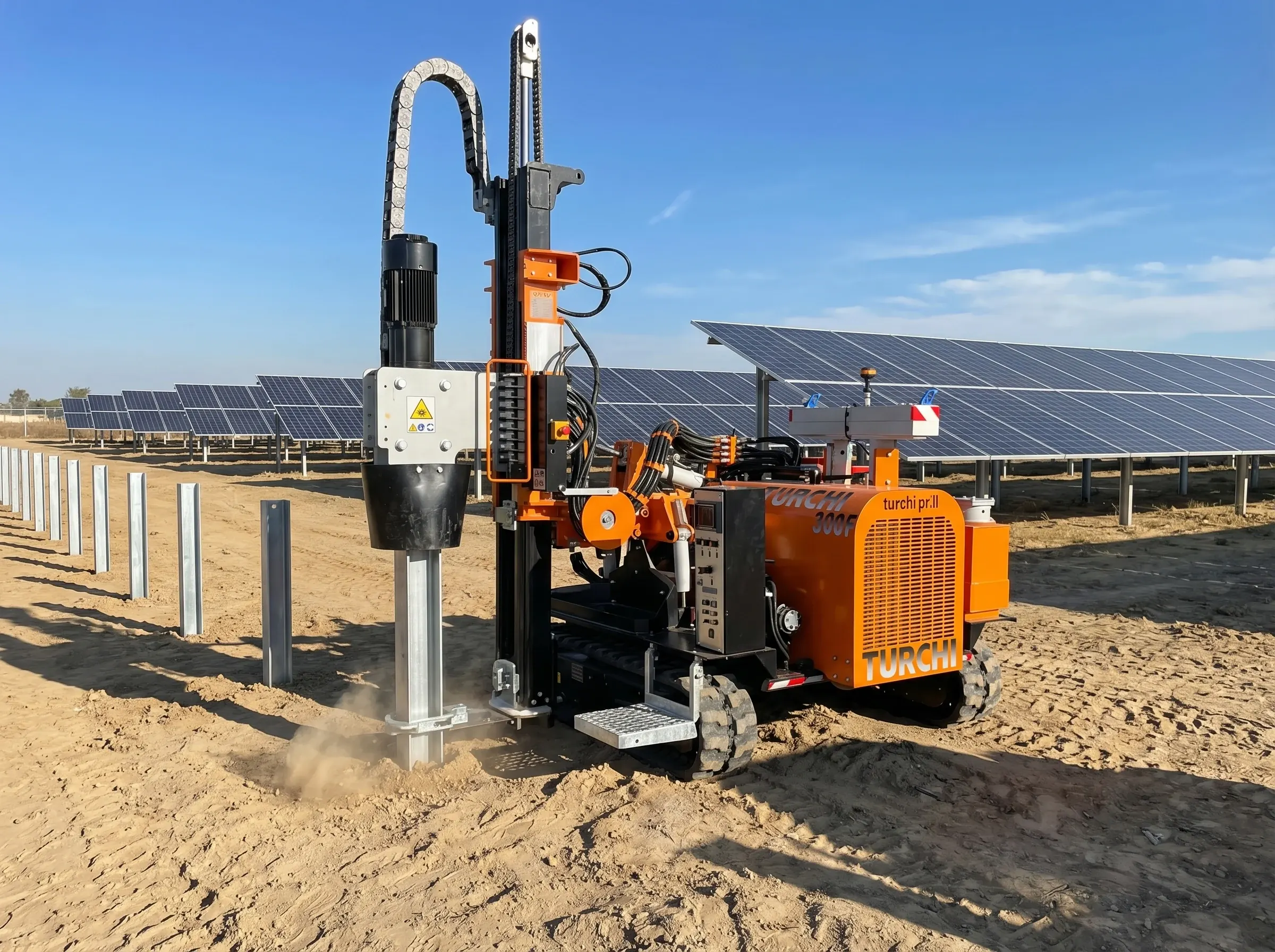
- Machine type
- Self-propelled tracked
- Working height
- 6 m
- Weight
- 4,400 kg
- Impact energy
- 950 / 1,200 / 1,500 J
- System pressure
- 180 bar
- Front tilt
- +10° / -51°
- Side tilt
- ±10°
Solar plants of 3+ MW and large projects
Complete guide
What it is, how it works, which one to choose. Everything you need to know before buying a hydraulic pile driver for solar sites, guardrails and foundations.
A pile driver is the machine that drives piles into the ground using the force of a hammer. In the hydraulic version, the hammer is powered by a high-pressure hydraulic circuit that lifts a ram and lets it fall with controlled energy dozens of times a minute. The result is precise, fast and repeatable driving.
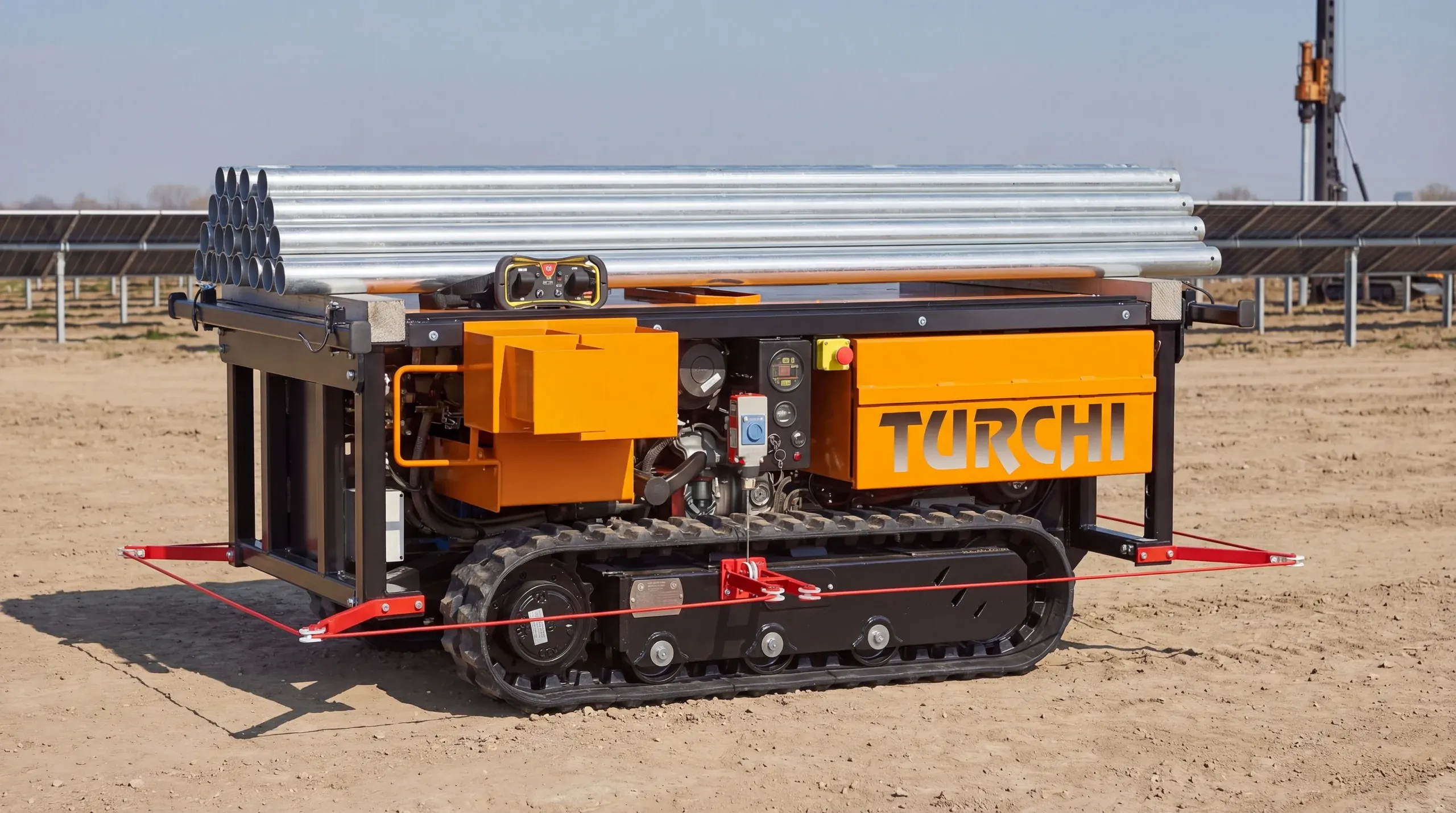
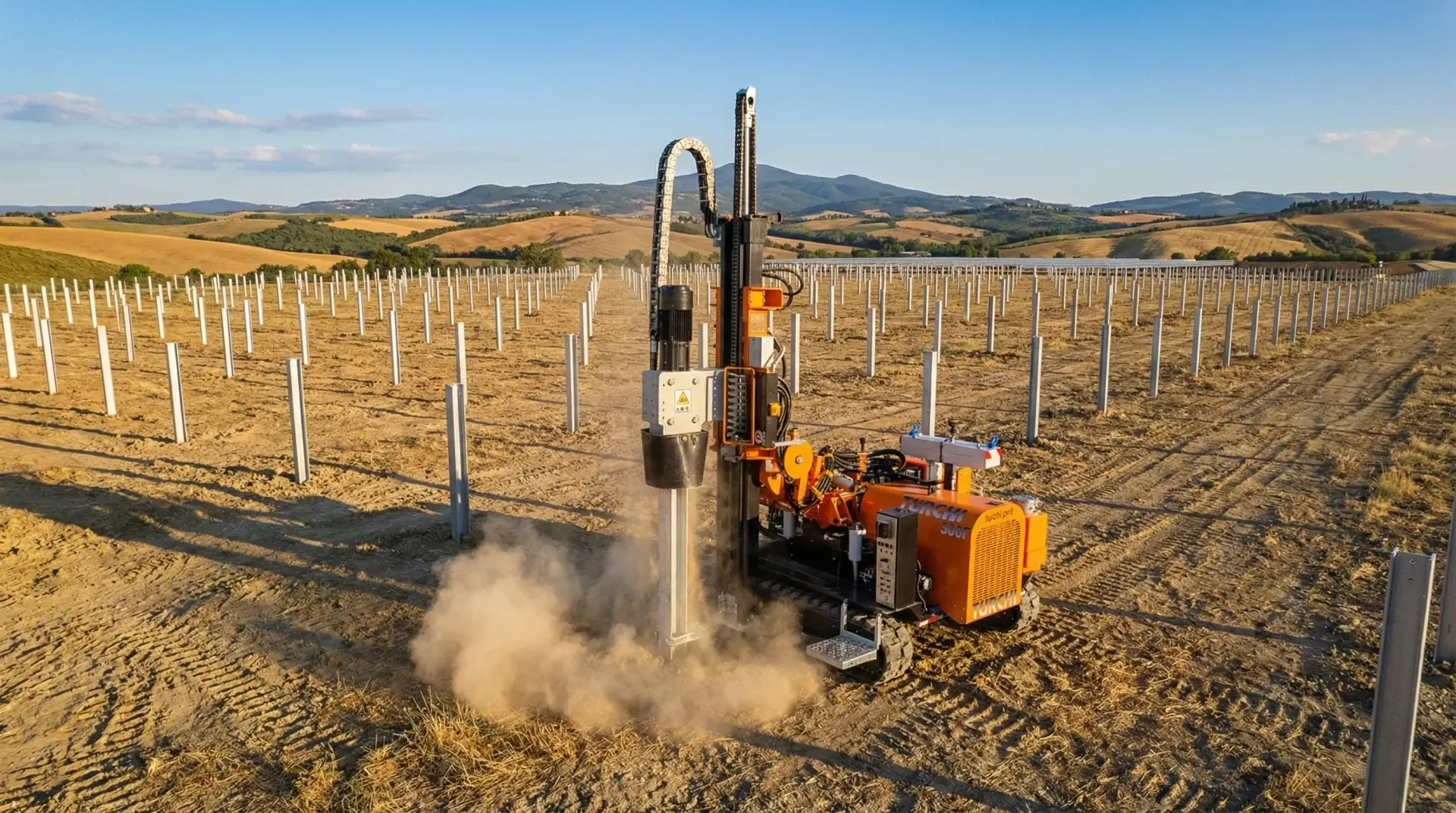
When people talk about a pile driver on site today, they almost always mean a self-propelled hydraulic one: a self-contained tracked machine that moves around the site under its own power, with no need for excavators, cranes or trailers. A single operator drives it and positions it over the piling line; the wireless remote control lets the operator run the driving from any position.
Over the past twenty years this class of machine has replaced traditional systems (manual pile drivers, excavator attachments, percussion pile drivers) on every site where piles have to be installed in large numbers, on tight schedules and with millimetre precision. It is the standard for ground-mounted solar plants, motorway guardrails, industrial fencing and precast foundations.
The heart of the machine is the hydraulic hammer, which runs a simple cycle repeated thousands of times a day:
Pressurised oil pushes the ram upwards inside a cylindrical guide. Stroke and energy are adjustable.
At the release point the ram falls under gravity, accelerated where needed by a hydraulic impulse. Impact energy is measured in Joule (J).
The ram strikes the pile head (or a protective helmet), transferring energy to the pile, which penetrates the ground.
The system repeats the operation at up to 60-90 blows a minute, keeping the driving steady with no loss of energy between one blow and the next.
The self-propelled version adds to this mechanism a self-contained tracked chassis, a hydraulic positioning arm and remote control. Travel, positioning and driving are all run from one place, with the wireless remote control.
The most frequent question when weighing up an investment in piling is whether to go for a dedicated self-propelled machine or an attachment mounted on the boom of an existing excavator. The differences are substantial.
| Feature | Excavator attachment | TURCHI self-propelled machine |
|---|---|---|
| Initial investment | Lower | Higher |
| Daily productivity | 40-80 piles/day | 150 piles/day |
| Operators required | 1 + excavator operator | 1 |
| Driving precision | Variable (depends on the operator) | Millimetre-level (sensors) |
| Excavator tied up | Yes, for the whole shift | No |
| Cost per pile | High (2 machines + 2 operators) | Low (1 machine + 1 operator) |
| Typical ROI | 18-24 months if in continuous work | 8-14 months on medium volumes |
An excavator attachment only makes sense for companies that do piling as an occasional activity (fewer than 5,000 piles/year). For everyone else, the self-propelled machine pays for itself from the first medium-to-large solar plant, thanks to double the productivity and half the crew.
A self-propelled hydraulic pile driver covers the main industrial pile-driving scenarios. The four main applications:
This is the dominant application today. A 1 MW plant needs 350-450 piles for fixed structures and up to 600 for single-axis trackers. The TURCHI 300F completes one MW in 3 working days with one operator, with custom dies for any pile profile.
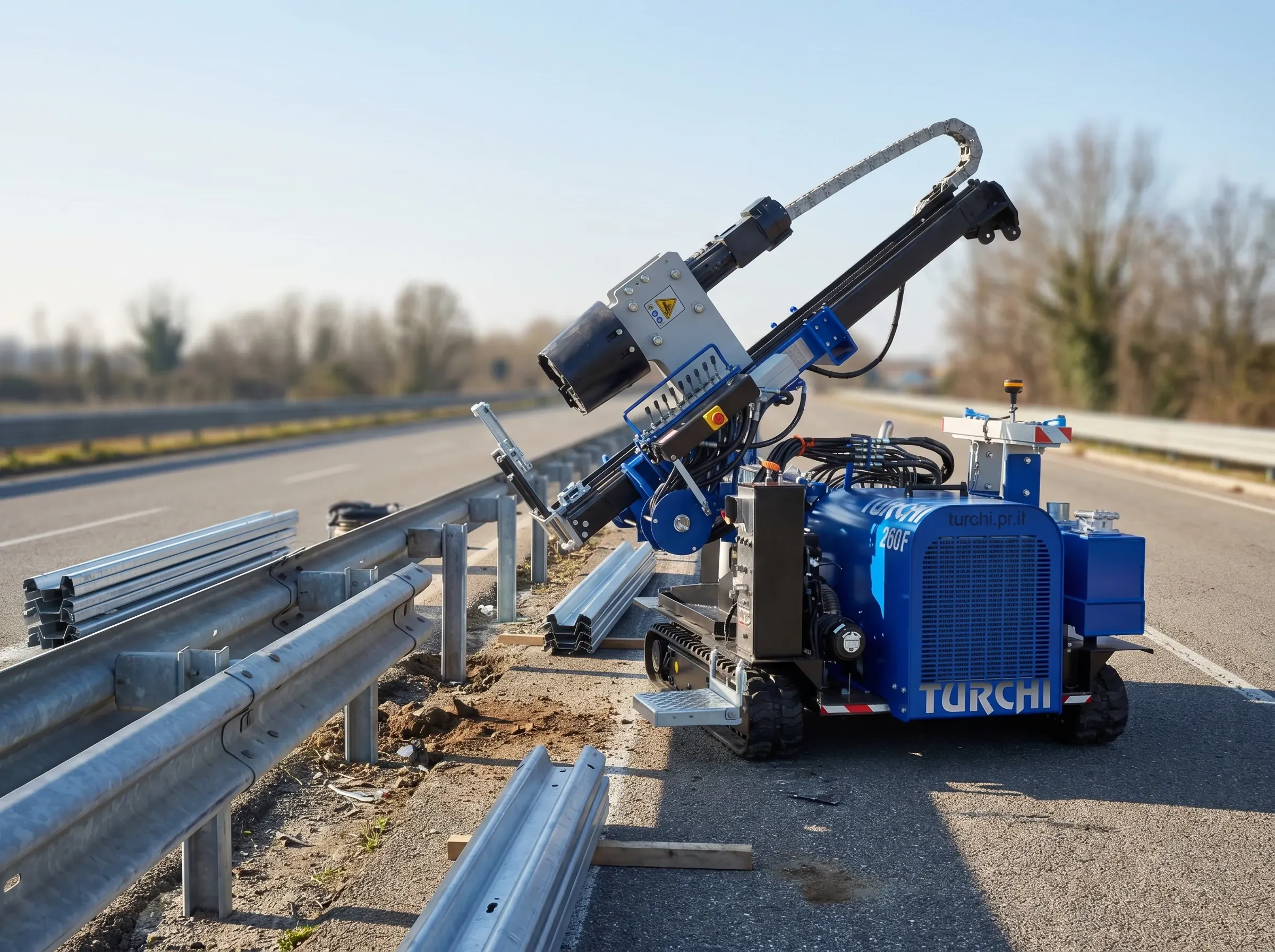
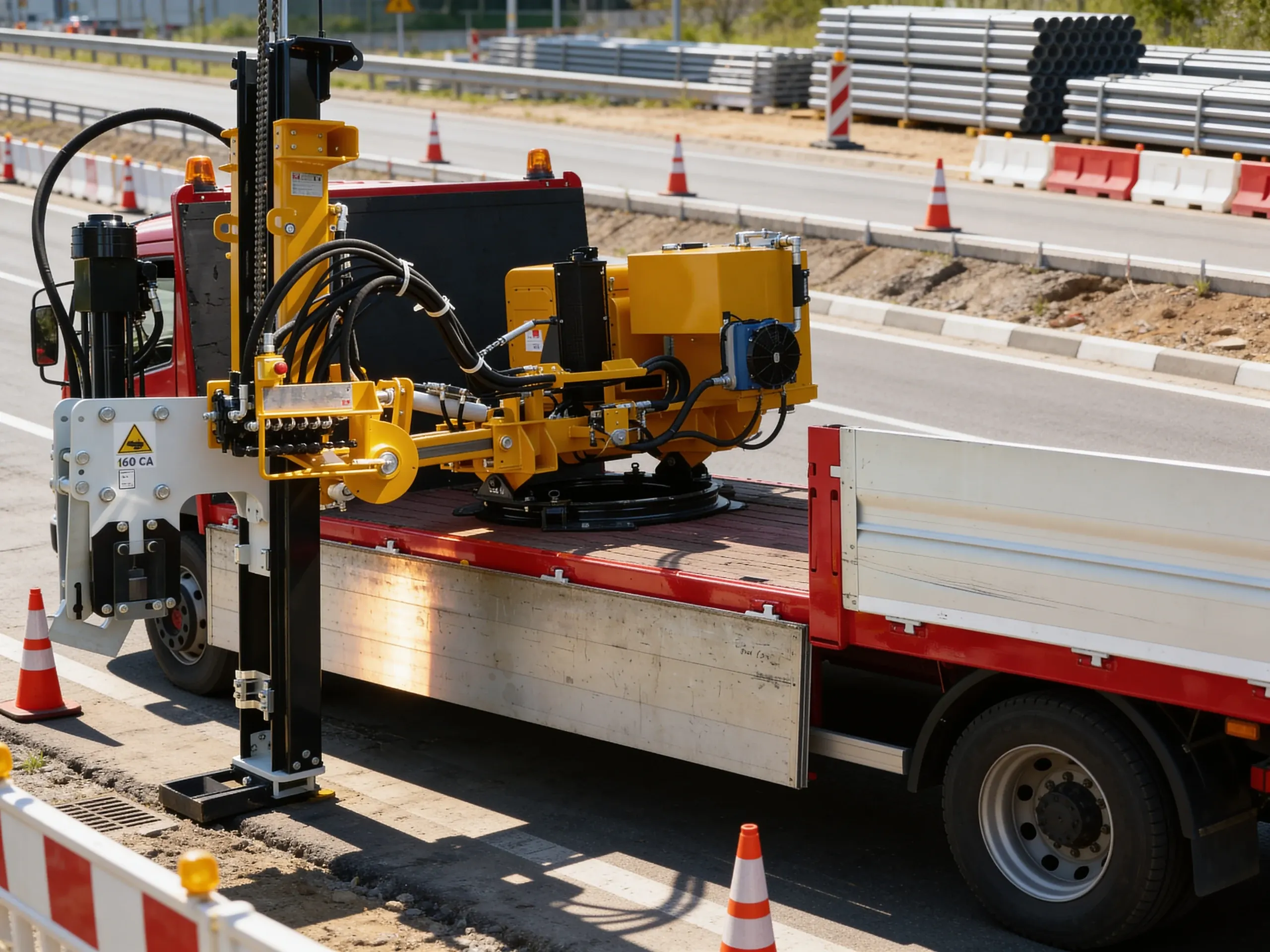
Motorway fencing, H2/H3/H4 guardrails, noise barriers, industrial fencing. A self-propelled pile driver advances along the line with no need to reposition an excavator, cutting site downtime.
Precast concrete or steel piles for point foundations. A cost-effective alternative to cast-in-place concrete, ideal when the ground allows driving and you want to cut site set-up time and cost.
With dedicated accessories, the machine also drives sheet piles, special profiles and micropiles for geotechnical works. The TURCHI 300F accepts different types of cap and protective helmet.
Solar in depth: to choose the pile driver best suited to your ground-mounted solar plant, compare self-propelled, excavator-mounted and truck-mounted machines in our complete guide to solar pile drivers , with technical criteria, real productivity and cost analysis.
Four parameters guide the choice. Clear answers on these points let you pick the right model without oversizing (a machine bigger than needed = higher fixed cost) or undersizing (a machine too small = a site that does not finish).
Typical depth ranges from 1.5 m (light solar structures) to 6 m (guardrails and heavy foundations). The machine's working travel must exceed the maximum requirement, because the protective helmet and the pile head take up part of it: a machine chosen at the limit will not finish the job.
H, C or U profile, tubular, sheet pile, precast concrete pile, micropile. Each type needs its own protective helmet and die. TURCHI supplies custom dies for any profile on request.
Above 5,000 piles a year (about 25 a day over 200 site days) a self-propelled machine pays for itself quickly; below that threshold an excavator attachment can still make sense, if piling is an occasional activity.
Hard or rocky ground calls for more energy per blow. Large or complex sites benefit from a machine with greater autonomy, for long shifts without frequent refuelling.
TURCHI Daniele SRL has been building self-propelled hydraulic pile drivers since 1973 at its plant in Pilastro (Parma). The current range runs from the medium-sized site to the large solar plant, with a single design philosophy: maximum reliability, minimum maintenance, one operator.
Solar plants of 3+ MW and large projects
Solar plants of 1-2 MW and road sites
Guardrails and mobile sites
Photovoltaic and road sites
The price of a new self-propelled hydraulic pile driver depends on the configuration. The model, the protective helmet, the specific dies for the pile profiles you use and, where needed, a transport trailer are the items that weigh most on the total.
The alternative to new is a used machine with warranty: full overhaul, worn components replaced, a shorter but real warranty. For companies approaching the pile driver market, it is often the most rational way into the segment before moving on to a new machine.
Many contractors wonder whether hiring makes sense. Hiring a self-propelled hydraulic pile driver typically costs €6,000-10,000 a month plus transport and a dedicated operator. If the job lasts more than a quarter, or more work is expected in the following 12 months, buying (or a used machine with warranty) is almost always the more economical route. TURCHI Daniele SRL is the manufacturer and does not hire out machines directly: for those looking for a hire arrangement, the authorised dealer network can offer dedicated solutions.
Return on investment depends on the annual piling volume. A realistic estimate: at 20,000 piles/year (roughly 50 MW of ground-mounted solar or 60 km of guardrail), the investment pays for itself in 10-14 months, taking into account the productivity gap over an excavator attachment, the saving of one operator and the saving on the dedicated excavator.
TURCHI provides a tailored quote within 12 hours of the request. The quote covers machine configuration, accessories, transport, operator training and service plan.
Can't find what you're looking for? Browse the full FAQ list. Reach out via a support request or email us at commerciale@turchi.pr.it.
With short piles, the TURCHI 300F works at around 150 piles a day as an indicative average, not a guaranteed minimum. In optimal conditions 200-300 piles a day can be reached; long piles, difficult subsoil, handling and the number of operators change the pace. Piles 6 metres long also need a helper and lifting equipment: do not use the short-pile average for that site.
In Italy the operator needs the qualification for operating tracked earthmoving machinery (State-Regions Agreement of 22/02/2012). TURCHI provides operator training on delivery.
Yes, with adequate energy per blow and specific dies. For very hard ground we recommend a machine with a higher-energy hammer (1,000 J and above). Where there are continuous rock layers, pre-drilling may be necessary.
For the 300F and the 260F the 500-hour service covers engine filters, a hydraulic oil cartridge and a breather oil filter; the kit changes with the model. Replacing the filters alone takes roughly 3-4 hours, which is not the duration of every full service. For the kit and the work, contact the service department stating the model and the machine's hours.
Yes, on a dedicated trailer or low-loader. The TURCHI 300F falls within the limits for ordinary abnormal-load transport in Italy. Below certain weights and widths the transport does not require an escort.
For non-standard profiles we make custom guides from the pile's technical drawing or from the necessary measurements: the kit includes the upper guide and the lower pile-centring collar. Production and shipping usually take 10-15 days. Pile height and ground conditions still have to be checked to choose the right model.
We review your site's requirements, choose the right configuration and send a detailed quote within 12 working hours.