Pile driver for solar: complete guide to choosing the right machine
Key takeaways
- A 1 MW plant requires approximately 350 piles: the driving machine is the heart of the jobsite.
- Self-propelled tracked pile drivers offer maximum autonomy and productivity with one operator.
- Minimum impact energy for solar H piles is 800 Joules.
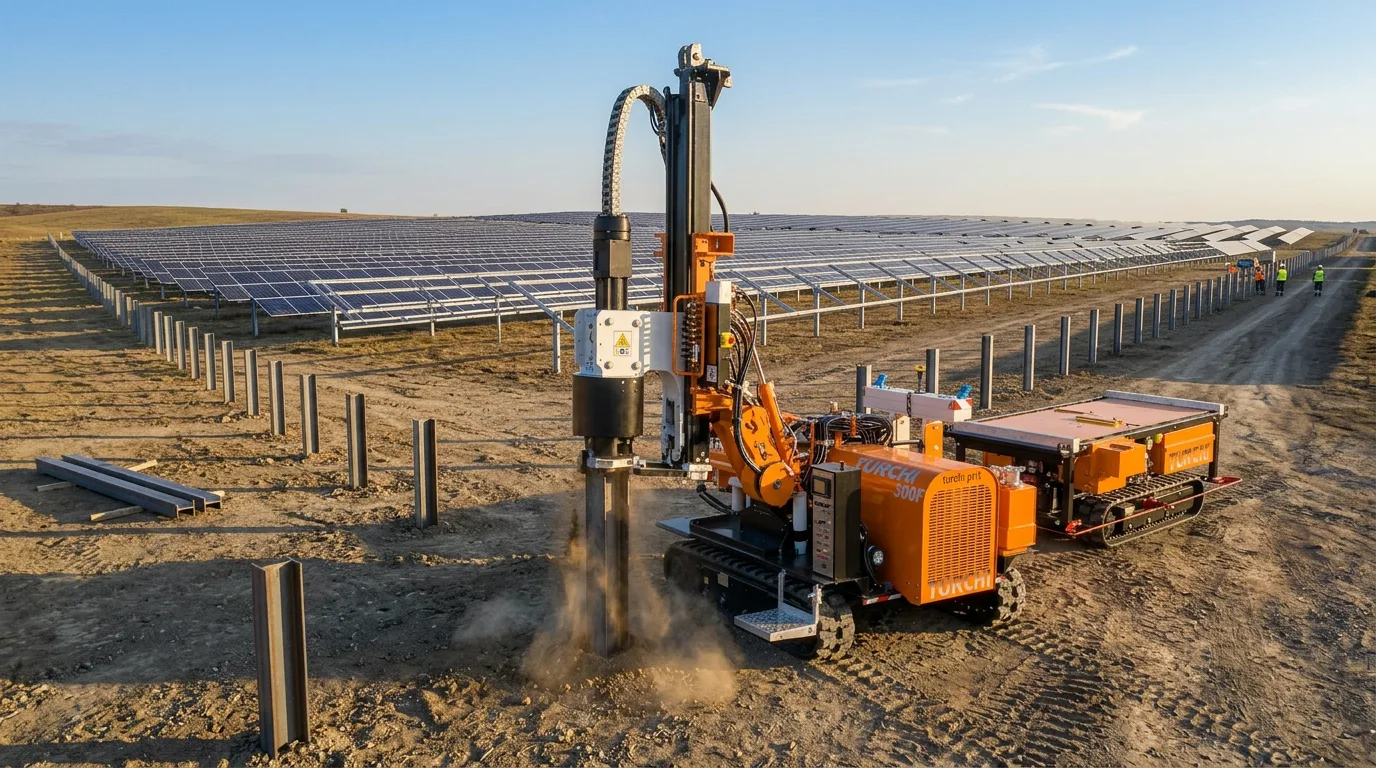
- With TURCHI 300F you can reach 150+ piles/day under real jobsite conditions.
- The break-even between rental and purchase is around 40-60 days/year of use (indicative estimate, varies based on local costs).
The role of the pile driver in solar installation
Ground-mounted solar energy is booming across Europe. Each megawatt of installed capacity requires approximately 350 foundation piles — H, C, U or Sigma metal profiles driven into the ground to support the panel-bearing structures. The exact number varies based on structure type, module layout and soil characteristics. For smaller plants or ballasted structures, the calculation differs. The machine that performs this operation, the self-propelled hydraulic pile driver, is the true productive heart of the solar jobsite. An efficient pile driver can halve construction times, reduce labor requirements and cut the cost per installed pile. An inadequate pile driver, on the other hand, generates delays, cost overruns and quality issues that impact the entire project. That is why choosing the right machine is not a technical detail: it is a strategic decision that directly impacts your project margin. For a full overview of the technology — how it works, how to choose it, indicative prices and ROI — see our complete guide to the hydraulic self-propelled pile driver. In this article we focus instead on the three main types of pile drivers for solar, the technical criteria to evaluate and the economic factors that should guide your decision.
Types of pile drivers for solar
The market offers three main categories of pile drivers for solar pile driving. Each has advantages and limitations that make it more or less suitable depending on the operational context.
Self-propelled tracked pile driver
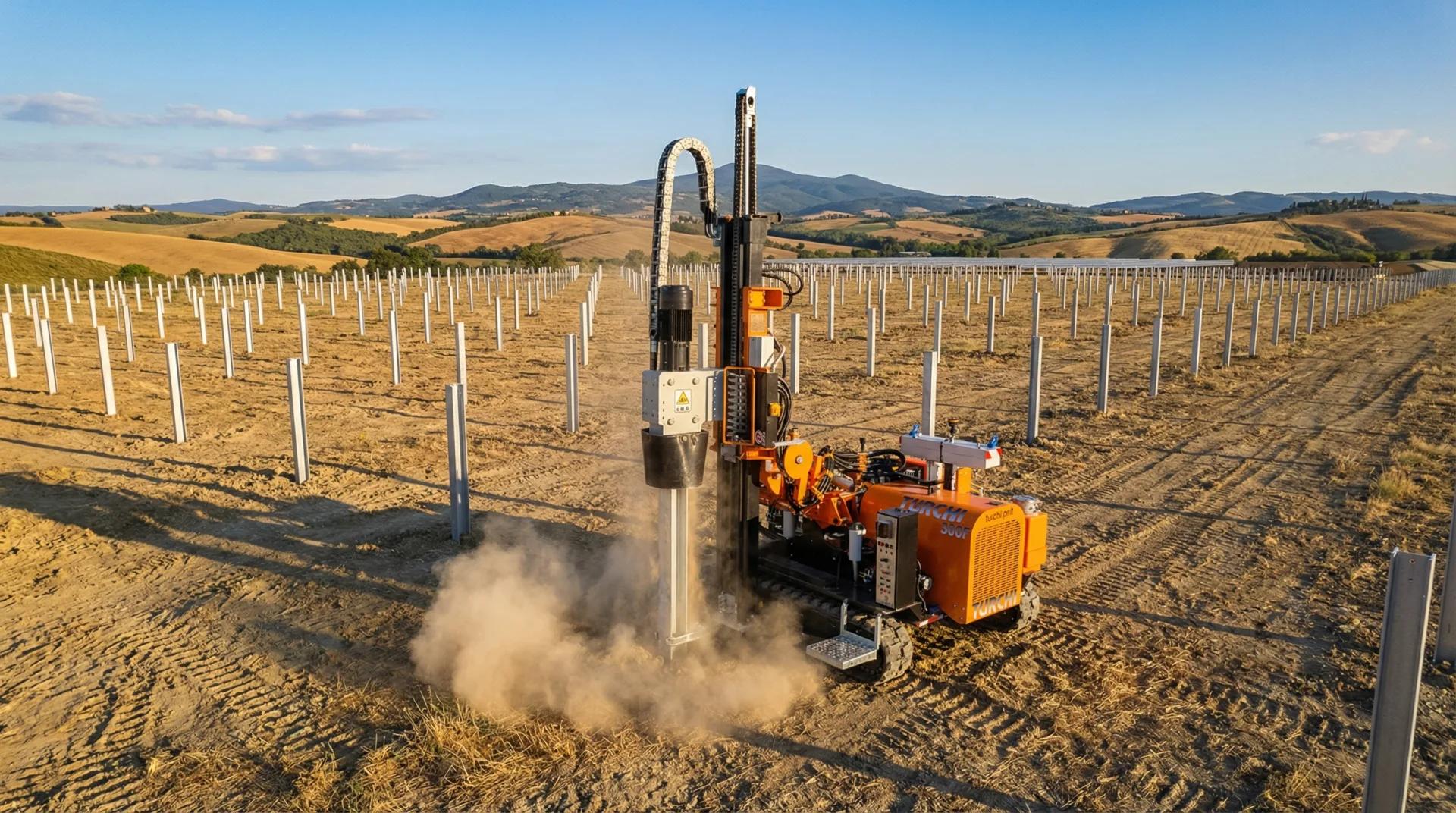
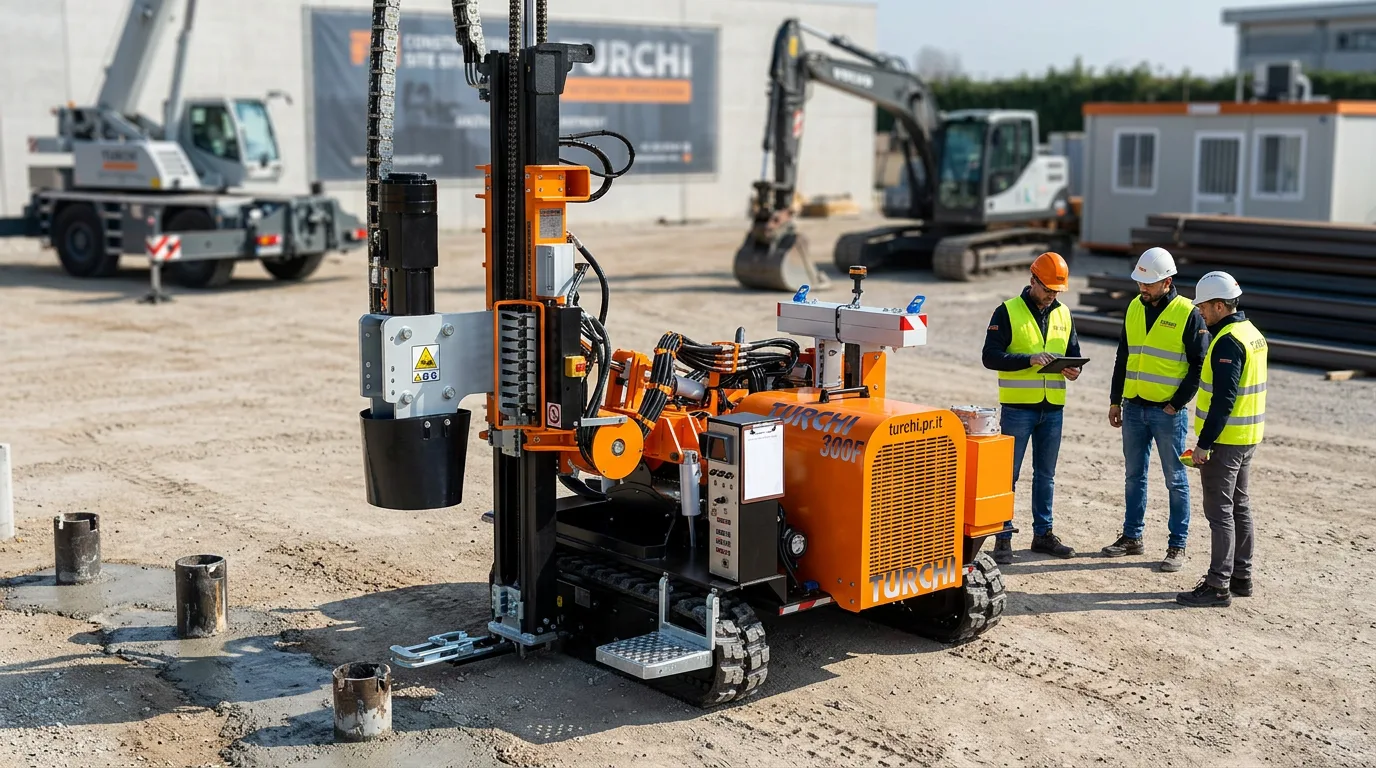
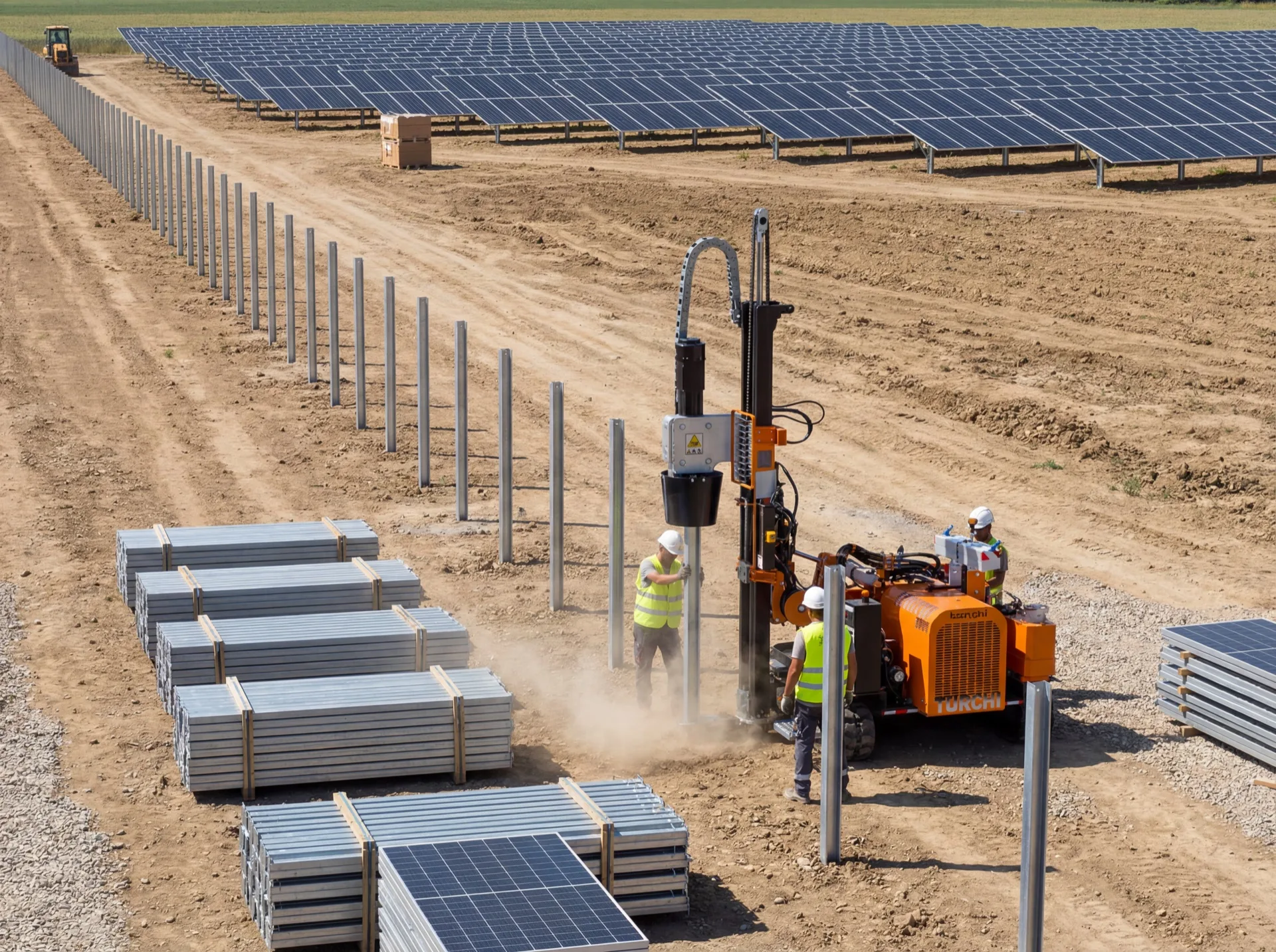
The self-propelled tracked pile driver, such as the TURCHI 300F, represents the most advanced solution for solar. It is a complete, autonomous machine: it moves independently on site, loads piles, positions them and drives them without needing support equipment. A single operator manages the entire cycle. The main advantages are total operational autonomy, the ability to work on difficult terrain thanks to tracks, high productivity (150+ piles/day with TURCHI 300F) and logistic simplicity. The disadvantages are a higher initial cost compared to other solutions and the need for low-loader transport for road moves. However, for sites with significant volumes (over 2,000 piles), the self-propelled unit is almost always the most economical choice in terms of cost per pile.
Excavator-mounted pile driver
The excavator-mounted pile driver consists of equipment (vibrating or percussion hammer) attached to the arm of an existing excavator. The main advantage is versatility: if you already own an excavator, the initial investment is lower. However, this solution requires a skilled operator, has lower productivity (typically 60-80 piles/day), needs a second vehicle for pile supply and ties up the excavator, preventing it from other work. For small sites or as a temporary solution it can make sense, but on significant volumes the total cost quickly exceeds that of a self-propelled unit.
Truck-mounted pile driver
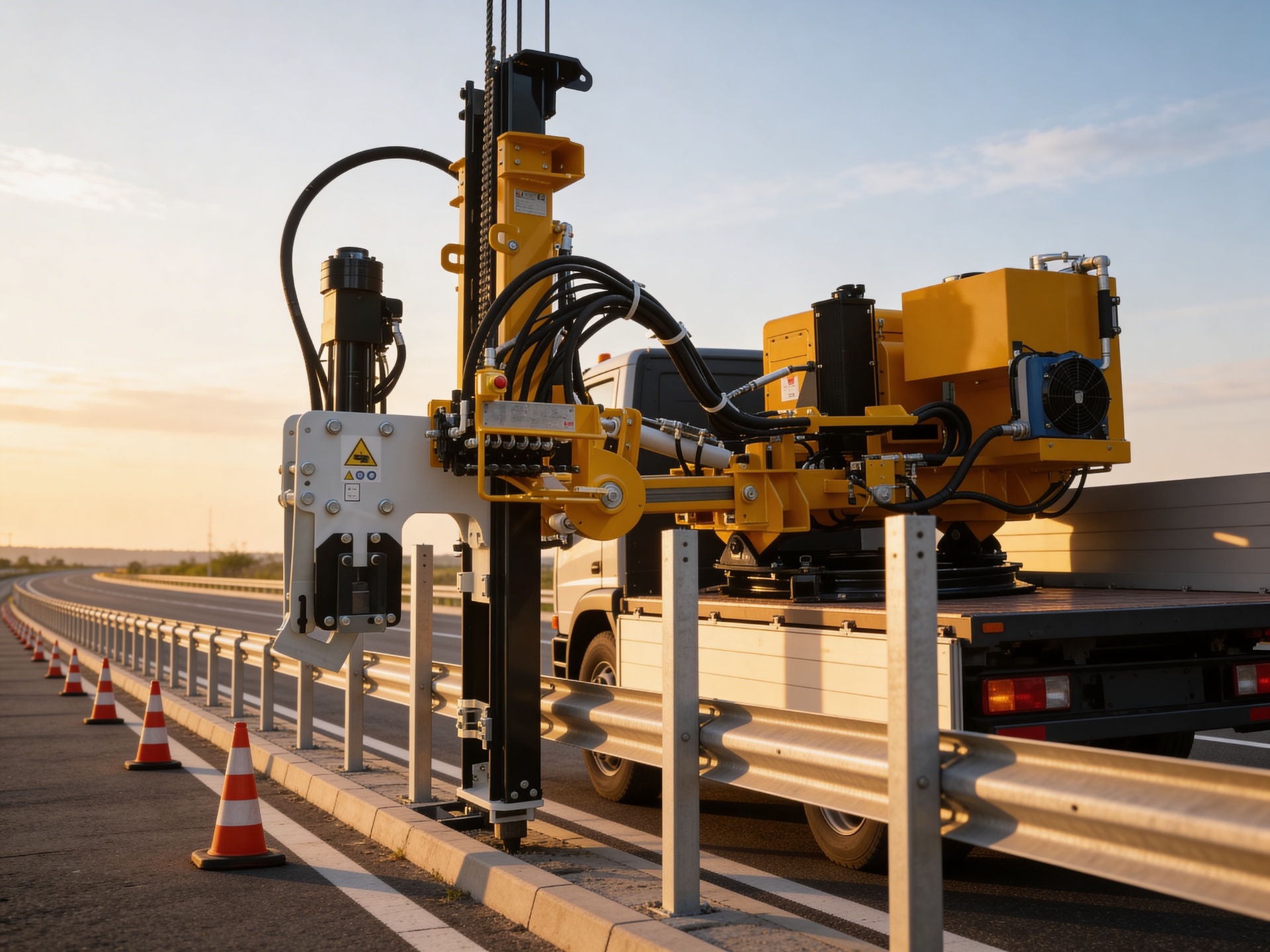
The truck-mounted pile driver offers the advantage of road mobility: it can move between sites without needing a low-loader. It is a very popular solution in the guardrail and fencing sector, less so in solar. The main limitations in solar are poor mobility on unprepared terrain, the need for a dedicated truck and moderate productivity. For solar sites on agricultural land, the limited maneuverability of the truck often represents a significant problem.
Our machine for solar
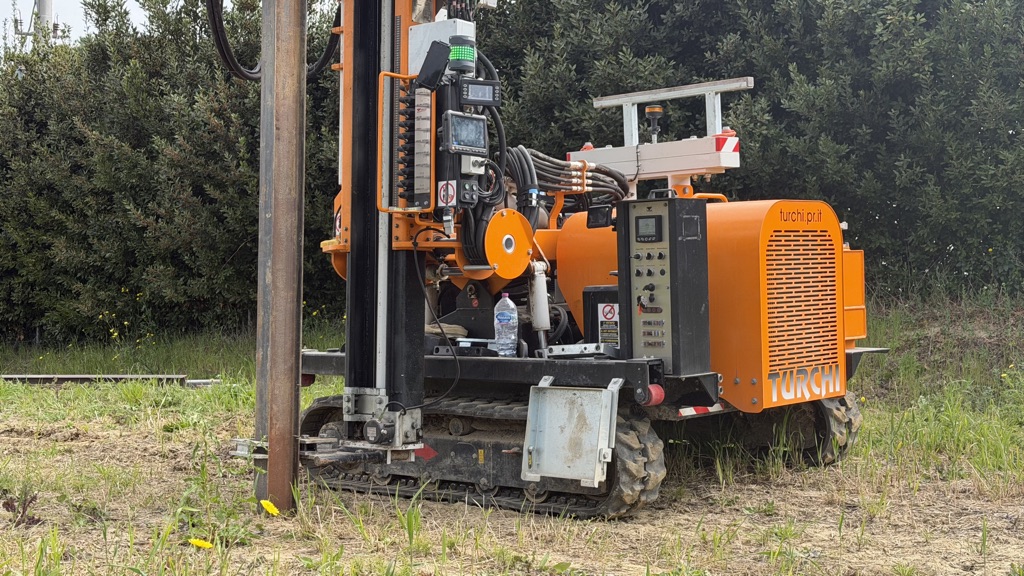
TURCHI 300F
Self-propelled hydraulic pile driver. 200 piles per day with a single operator.
Selection criteria: what to evaluate
Choosing the right pile driver depends on five fundamental technical factors that every site manager must carefully evaluate before purchase or rental.
Impact energy (Joules)
For driving standard H piles for solar (profiles from 60x60 to 120x120 mm), the minimum recommended energy is 800 Joules per blow. However, for compact or clay soils it is preferable to have at least 1,000-1,200 Joules to maintain consistent production rates. The TURCHI 300F delivers up to 1,200 Joules, ensuring optimal performance even in the most demanding conditions. Be careful with manufacturer data: "nominal" energy and "effective energy at pile" can differ significantly.
Working height
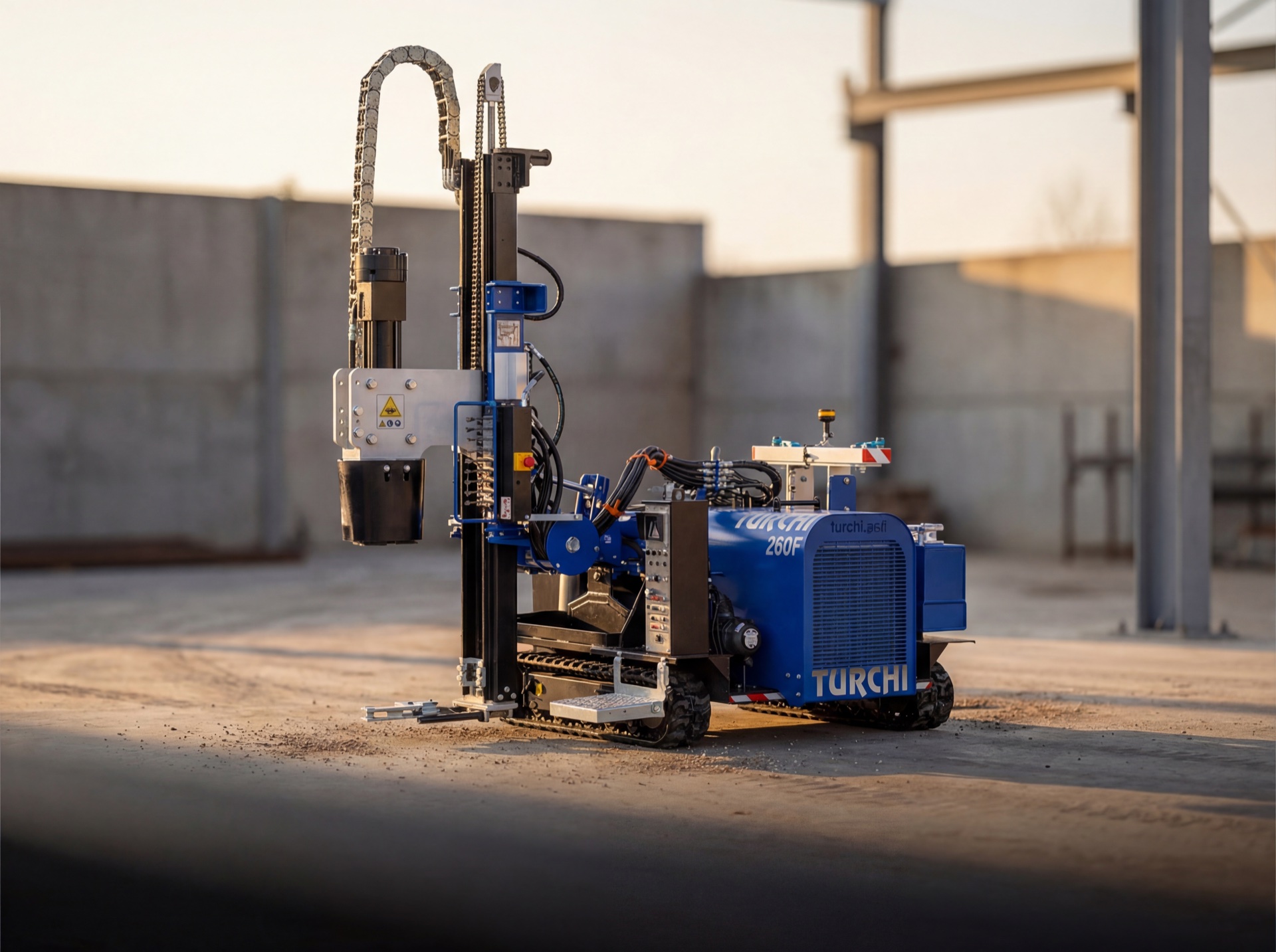
Working height determines the maximum pile length you can drive. For solar, the most common heights are 3-4 meters for standard installations and 4-6 meters for trackers and elevated systems. Verify that the chosen machine covers your project's height range without compromise. TURCHI machines offer configurable working heights from 3.5 m with the TURCHI 260F up to 6 m with the TURCHI 300F.
Real productivity (piles/day)
Beware of "lab" numbers. Real productivity depends on terrain, pile logistics, driving depth, weather conditions and operator skill. Always ask for verifiable jobsite data, not theoretical specs. With TURCHI 300F, average productivity on solar sites is 150+ piles/day under standard conditions, with peaks over 200 under optimal conditions. Learn more on the TURCHI 300F product page.
Automation and technology
Modern machines can be equipped with optional assistance systems that increase productivity and quality: semi-automatic GPS/GNSS for pile positioning on the project map, electronic verticality assistance to ensure alignment, remote monitoring to control the machine from the office. These features, available as options, measurably reduce errors, rework and downtime on sites with thousands of piles. The solar sector benefits the most from these technologies.
The ground makes the difference
Soil type is the most influential factor in pile driver selection and jobsite productivity. A preliminary geotechnical assessment is always recommended, especially for large installations.
Normal and sandy soils
On sandy, silty or gravelly soils, driving is direct and fast. These are ideal conditions for any pile driver, with maximum productivity. The only concern is pile holding capacity over time: in very sandy soils, greater depth may be needed to ensure structural stability.
Clay soils
Clay requires more energy for driving and can cause "set-up": the pile appears to have reached refusal but after a few minutes can be driven further. It is important to have energy reserve (at least 1,000 Joules) and monitor actual depth. During rainy periods, wet clay can compromise machine stability: the wide tracks of a self-propelled unit offer a decisive advantage over truck wheels.
Rocky soils
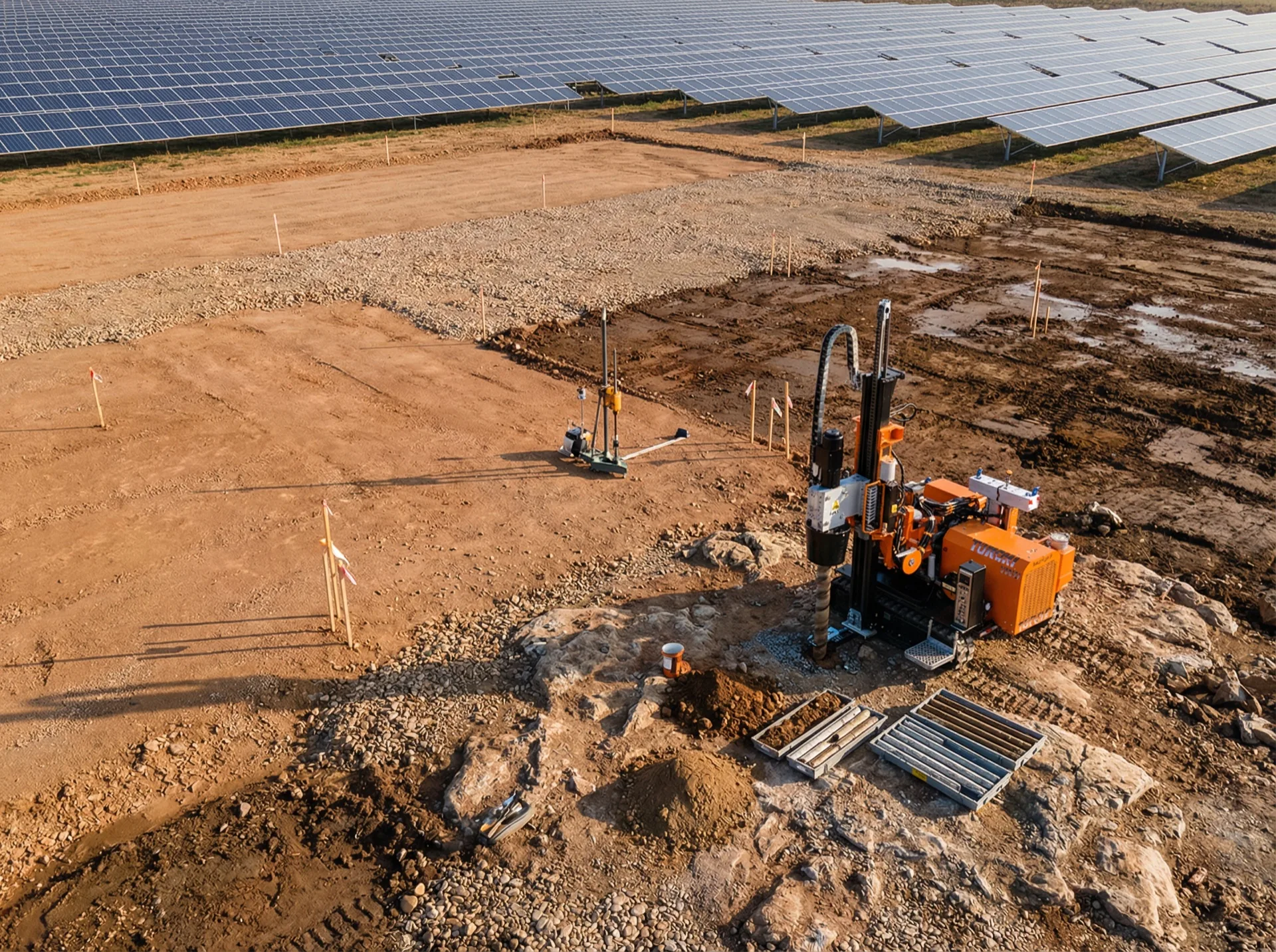
When rock is encountered, direct driving is not possible. The solution is pre-drilling with a pneumatic drill (down-the-hole), followed by driving the pile into the prepared hole. This operation reduces productivity but is the only alternative to concrete foundations, which are much more expensive. TURCHI machines can be equipped with a pneumatic down-the-hole drill mounted directly on the machine as an integrated accessory, keeping the entire process on a single machine.
Rental vs purchase: when each makes sense
The most frequent question among solar operators concerns the choice between rental and purchase. The answer depends on annual work volume. The indicative cost of wet rental (machine + operator) in Italy starts at approximately €1,000/day and varies significantly by area, machine and seasonality. Considering that a quality self-propelled pile driver has a purchase price that is tax-deductible under current regulations, the break-even point typically falls around 40-60 days of use per year. If you use the pile driver more than 60 days a year, purchasing is almost certainly more economical — and makes you independent of rental availability, which during peak periods can be a serious problem. For a detailed cost analysis, read our dedicated article on rental vs purchase with ROI calculation.
Not sure which model fits you?
Configure your TURCHI in 2 minutes — quote within 12 hours.
Open the configuratorWhy self-propelled pile drivers are dominating the market
Over the past five years, self-propelled tracked pile drivers have gained an increasing market share in the solar sector, at the expense of excavator or truck-mounted solutions. The reasons are clear: one operator instead of 3-4 people (excavator driver + assistants), no dependence on external cranes or support vehicles, operational setup in minutes instead of hours, mobility on any terrain thanks to tracks, and consistent, measurable productivity. Our customers' experience confirms these figures: with a TURCHI 300F, a single operator drives an average of 150 piles per day on normal ground, with peaks over 200. With approximately 350 piles per MWp, this means completing a 1 MW plant in less than 3 working days with a single machine and a single operator. To explore available models and find the ideal configuration for your site, visit the model comparison page or start the online configurator directly to receive a personalized quote within 24 hours.