Guardrail regulations EN 1317: what road barrier installers need to know
Key takeaways
- EN 1317 regulates the design, testing and installation of road restraint systems.
- Containment classes (N1-H4b) determine where each type of guardrail can be installed.
- CE marking has been mandatory since 2011 for all restraint systems sold in Europe.
- Correct depth and verticality of piles are essential requirements for compliance.
- Semi-automatic GPS (optional) in the pile driver helps ensure the precise spacing required by the standard.
Road safety is an obligation, not an option
Every year, in Italy and across Europe, thousands of road accidents are mitigated by restraint systems — guardrails, central barriers and terminals. These systems are not simple metal sheets along the road: they are safety devices designed, tested and certified according to rigorous standards. Those who install guardrails have an enormous responsibility: a non-compliant installation can cost lives. The reference standard in Europe is EN 1317, a body of technical standards that regulates every aspect of road restraint systems, from design to crash testing, from installation to maintenance. In this guide we explain the fundamental concepts every installer needs to know to operate in compliance and safety.
History of Italian and European regulations
Italian regulations on road barriers have a long and complex history. The main Italian ministerial decrees on road barriers, from the 1992 DM through subsequent updates, have progressively aligned national regulations with European standards. EU Regulation 305/2011 (CPR) made CE marking mandatory for all construction products, including road barriers. Today, the reference standard is EN 1317 in its various currently applicable parts, which harmonizes requirements across the entire European Union. The regulatory evolution has led to increasingly rigorous standards, with real crash tests (not simulated) and measurable performance requirements.
EN 1317 explained
EN 1317 is composed of several parts, each dedicated to a specific aspect of road restraint systems. Part 1 defines terminology and general criteria. Part 2 specifies performance classes and acceptance criteria for safety barriers, based on crash tests with real vehicles. Part 3 covers terminals and crash cushions. Part 4 covers temporary barriers for work zones. Subsequent parts deal with specialized aspects such as motorcycle barriers and criteria for in-service evaluations. The key concept of the standard is that every restraint system must be classified through real crash tests, not theoretical calculations.
Containment classes: where each type is used
Containment classes define the barrier's ability to stop vehicles of different masses and speeds. Class N1: containment of light vehicles (900 kg). Typical use: low-speed urban roads, parking lots. Class N2: containment of medium vehicles (1,500 kg at 110 km/h). Typical use: secondary extra-urban roads. Class H1: containment of heavy vehicles (10,000 kg). Typical use: highways and expressways. Class H2: containment of buses and heavy vehicles (13,000 kg). Typical use: highway central barriers, bridges. Class H3: containment of heavy vehicles (16,000 kg). Typical use: high-risk zones, elevated embankments. Class H4b: containment of very heavy vehicles (38,000 kg). Typical use: bridges and viaducts with heavy traffic. The parameters listed are indicative references based on EN 1317-2. For exact test condition values, refer to the full standard text.
Want to pick the right model for your site? Talk to us.
CE marking: obligations and responsibilities
Since 2011, CE marking has been mandatory for all road restraint systems sold in the European Union. CE marking must contain: manufacturer name and address, year of application, conformity certificate number, reference to the harmonized standard (EN 1317-5), containment class, impact severity level and deflection. CE marking responsibility lies with the restraint system manufacturer. However, the installer is responsible for: verifying the system is CE marked, installing it per manufacturer specs without modifications, documenting the installation with a laying report, and retaining documentation for at least 10 years.
Where guardrail installation is mandatory
Italian regulations identify several situations where installation of restraint systems is mandatory: bridges and viaducts (always), central barriers on dual carriageway roads, embankments higher than 1 meter, dangerous curves with radius below regulatory limits, road sections with fixed lateral obstacles (trees, poles, walls), interchanges and grade-separated intersections, and zones with a history of serious accidents.
The role of the pile driver in compliant installation
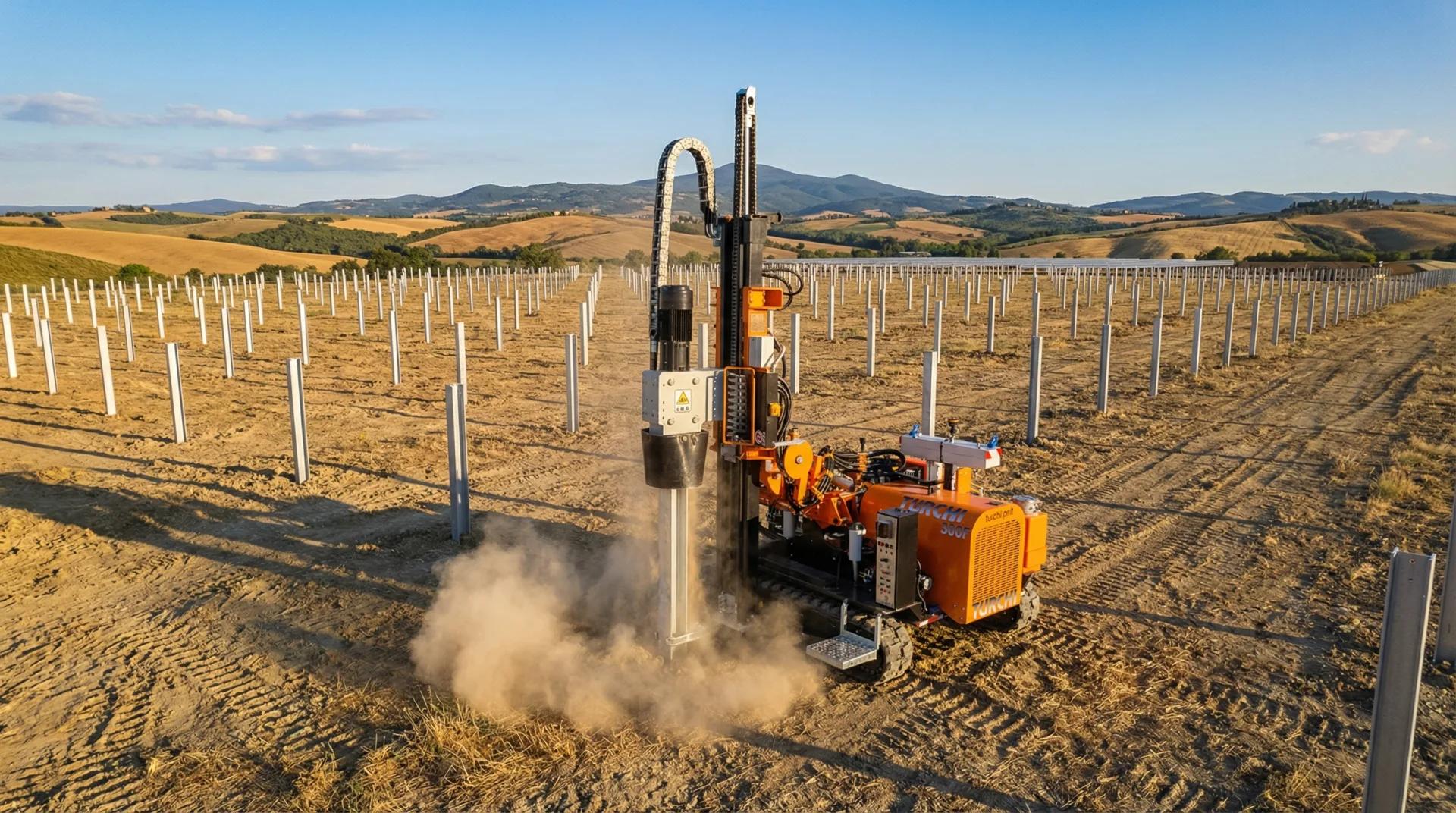
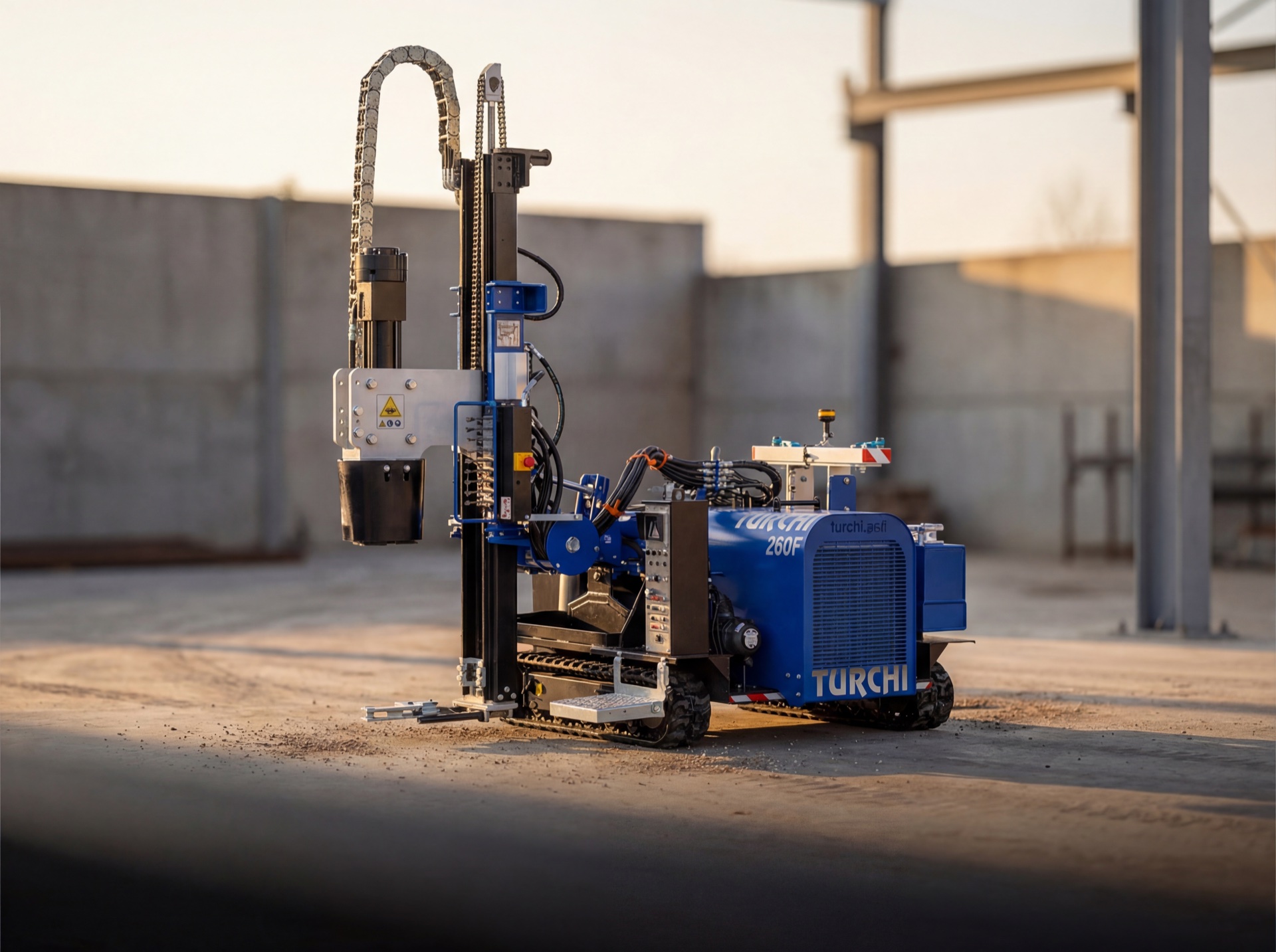
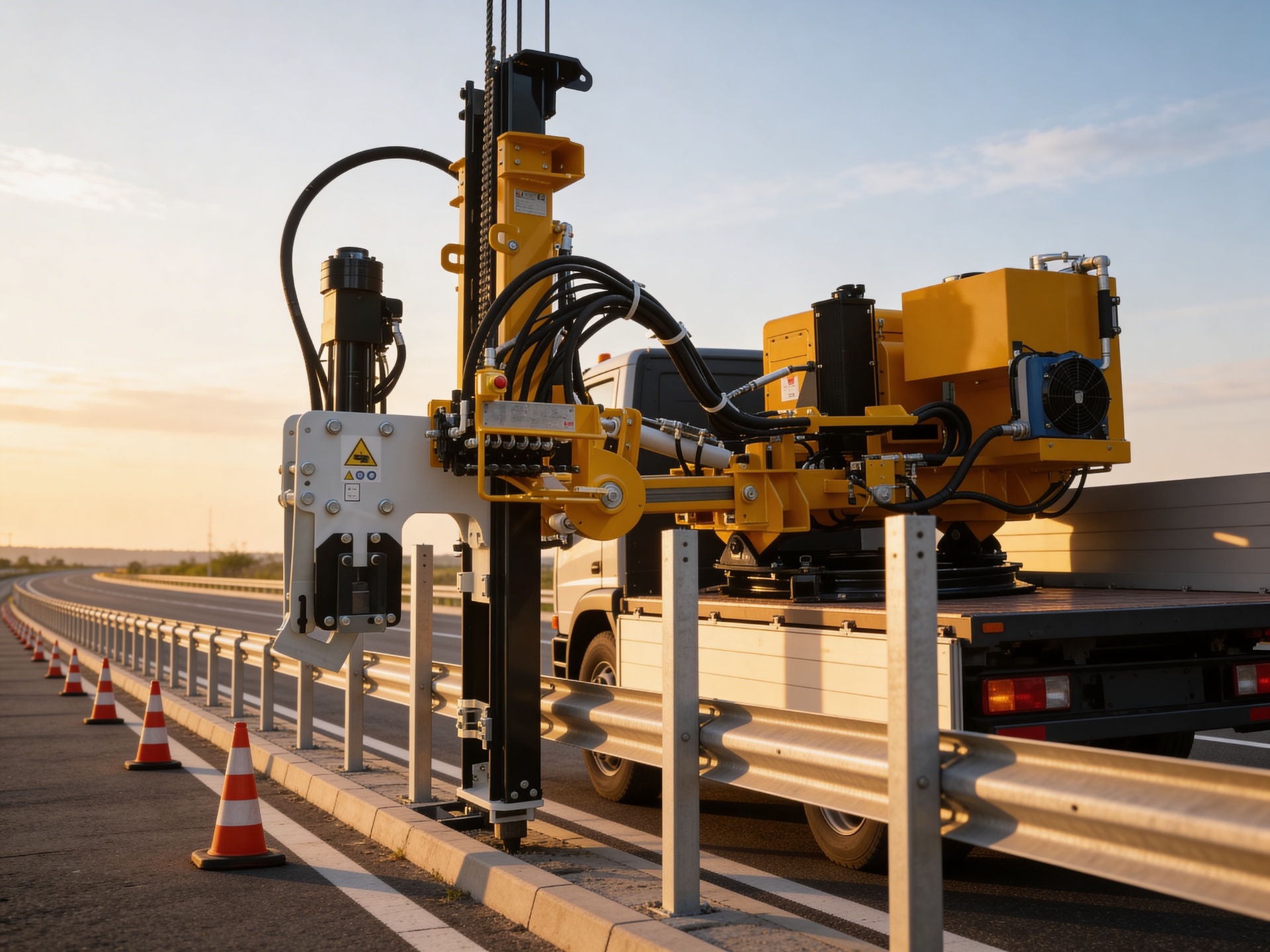
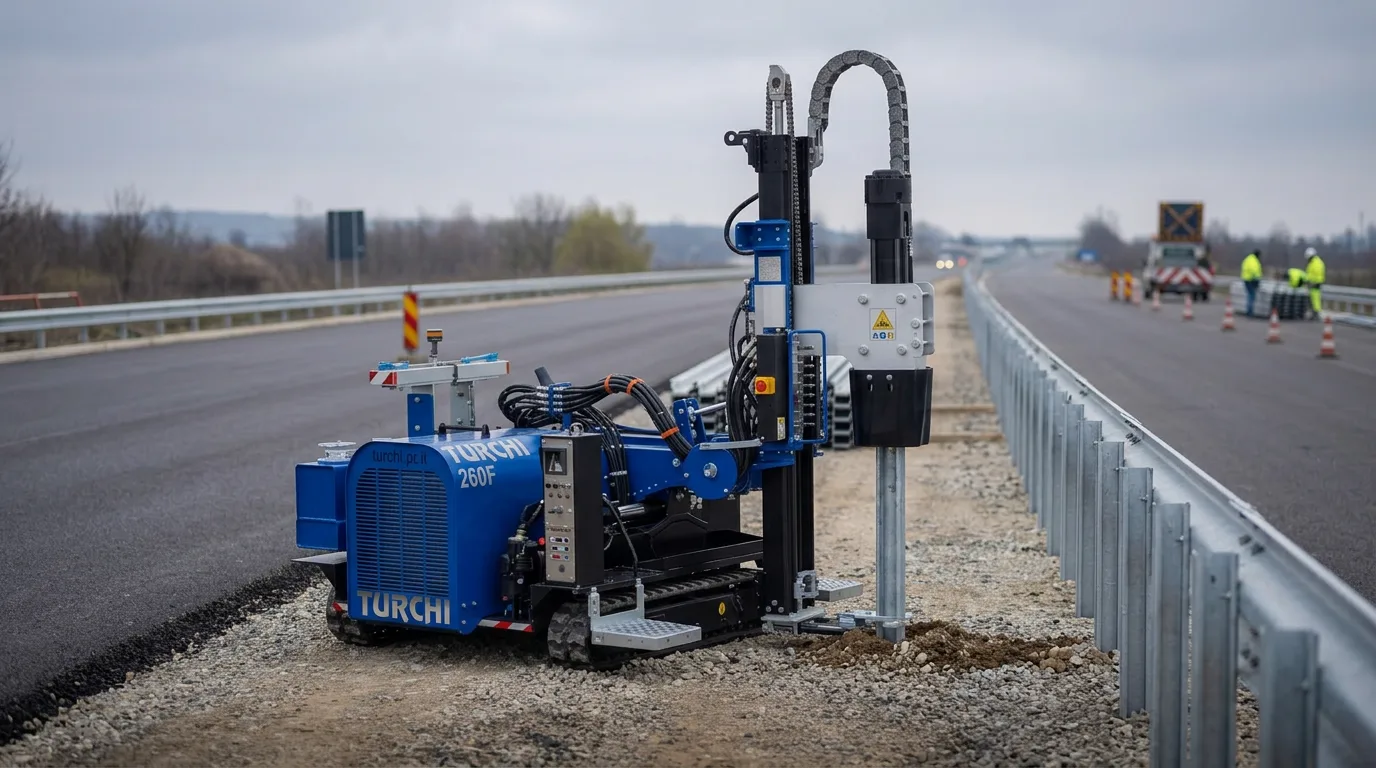
Compliant guardrail installation depends on three critical mechanical parameters that the pile driver must ensure: correct driving depth (typically 1.2-1.5m for standard sigma piles), pile verticality (maximum deviation of 1-2° from vertical), and precise spacing between piles (typically 2 or 4 meters, per design). A modern pile driver like the TURCHI 260F can be equipped with optional accessories that simplify compliance with these parameters: electronic verticality assistance (optional), semi-automatic GPS for exact positioning (optional), remote control for distance operation (optional). These technologies, when installed, not only support regulatory compliance but increase productivity and reduce errors, which on a road site mean costly and potentially dangerous rework. To discover how the TURCHI 260F can improve the quality and efficiency of your road projects, visit the product page or contact us for a demonstration.