Solar farm construction: costs, timeline, and project phases for ground-mount PV
Everything you need to design and build a utility-scale solar farm: foundation piles, MW-by-MW timeline, current 2026 costs, ROI, and incentive frameworks. Written by the manufacturer of pile drivers for solar parks from 500 kW to 50 MW.
Table of Contents
What is a ground mount solar farm
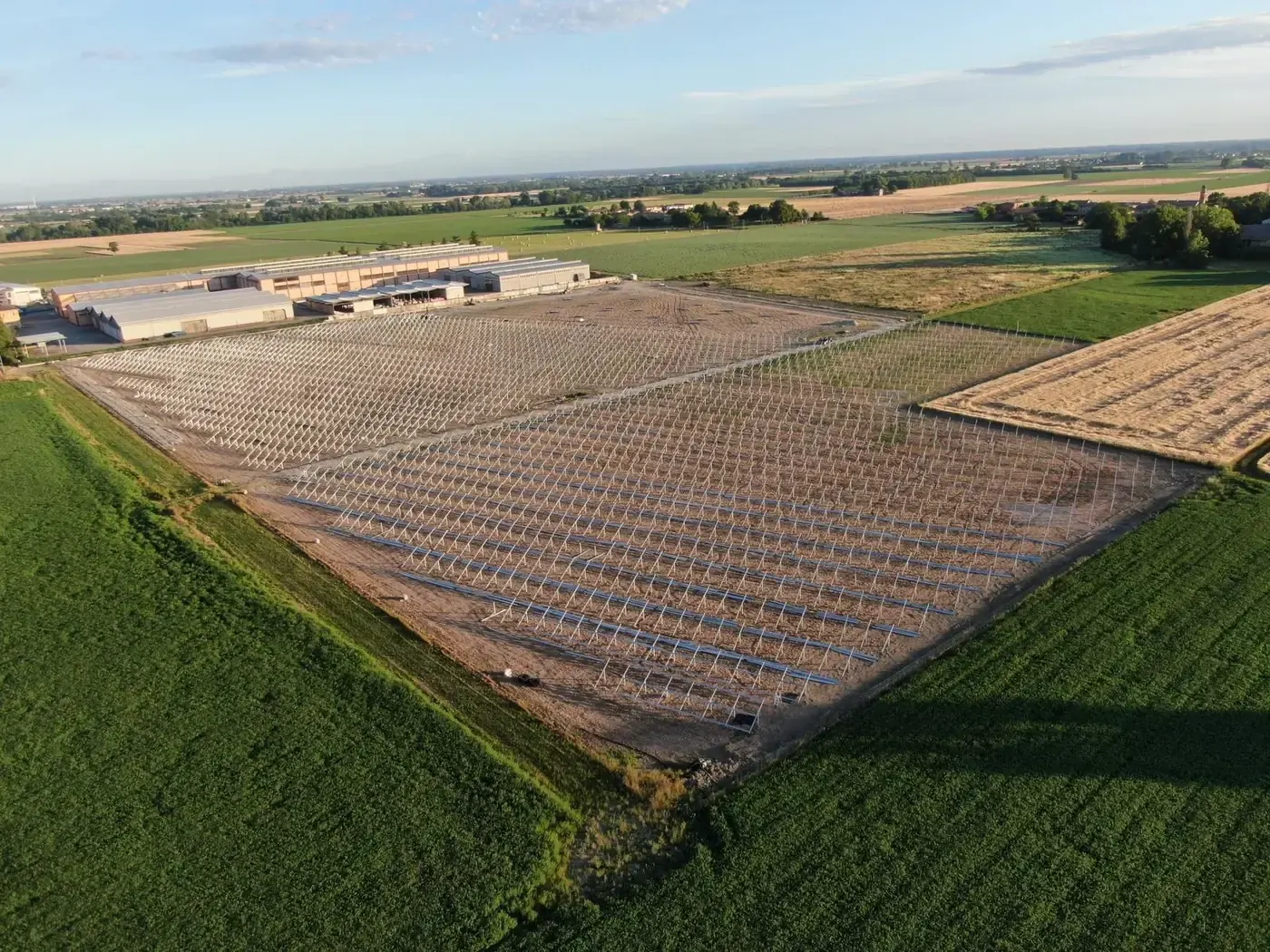
A ground mount solar farm is a power generation facility composed of dozens to thousands of photovoltaic modules installed on metal racking fastened directly into the ground. Unlike rooftop installations, the solar farm develops on marginal agricultural land, brownfield industrial sites, or dedicated parcels: this makes it the standard solution for capacities above 500 kW and up to 50 MW and beyond.
The most important difference compared to residential solar isn't size — it's project logic. In a solar farm the dominant constraint is the density of foundation piles: each MW requires between 350 and 450 piles for fixed-tilt structures, and up to 600 for single-axis trackers. The quality of pile driving determines the structural lifetime of the installation across its 25-30 year service life.
A modern solar farm is not simply an array of panels: it's an engineering project that integrates geotechnical evaluation of the soil, pile profile selection, mechanized pile driving, optional BESS storage, monitoring systems, and high-voltage grid interconnection. Whoever gets the foundation phase wrong will pay extraordinary maintenance costs for the entire life of the system.
Key components of a solar farm
Understanding how solar farm cost decomposes lets you evaluate which line items are compressible and which are not. The six main categories:
Photovoltaic modules
35-45%The largest cost line and the one with the widest negotiation margins. Mono-PERC 600 W modules are now the standard, but the choice between Tier 1 manufacturers (Chinese, European, Korean) has significant impact on warranty, performance, and trade tariff exposure.
Racking (tracker or fixed-tilt)
8-12%Single-axis trackers or fixed-tilt structures. Trackers produce 15-25% more energy but cost twice as much and require more maintenance. The choice depends on latitude, soil type, and target IRR.
Foundation piles and driving
5-8%Piles are the structural element connecting the array to the ground for 25 years. Galvanized steel C or H profiles, length 2-3.5 m, driven with hydraulic self-propelled pile driver. A typical MW requires 350-450 piles for fixed-tilt and up to 600 piles for trackers.
Inverters and electrical BoS
10-14%Central or string inverters, DC and AC cabling, combiner boxes, step-up transformer, MV switchgear. The choice between central and string impacts cost, reliability, and downtime exposure.
HV interconnection
5-12%Connection to the substation. This is the most variable line item: a project near a substation may get away with a few hundred thousand dollars, an isolated one may require kilometers of dedicated transmission line.
Permitting, design, construction management
12-20%Environmental impact studies, interconnection studies, engineering design, construction management, safety, local fees, grid connection. In the US, permitting timelines are the most unpredictable line item and can range from 12 to 36 months depending on jurisdiction.
Foundations: why piles are the critical project decision
The foundation phase represents only 5-8% of total solar farm cost, but 100% of structural risk. An installation with poorly driven piles will produce for its entire service life with misalignment that reduces yield, eccentric loads that stress structures, and in worst cases settlements that require replacement of entire tracker rows.
There are two solutions for solar farm foundations: piles driven with hydraulic pile drivers, or cast-in-place concrete footings. Pile driving is the dominant choice in 90% of solar parks because it eliminates concrete cure time (7-28 days), requires no formwork, generates zero construction waste, and delivers consistent quality independent of weather conditions.
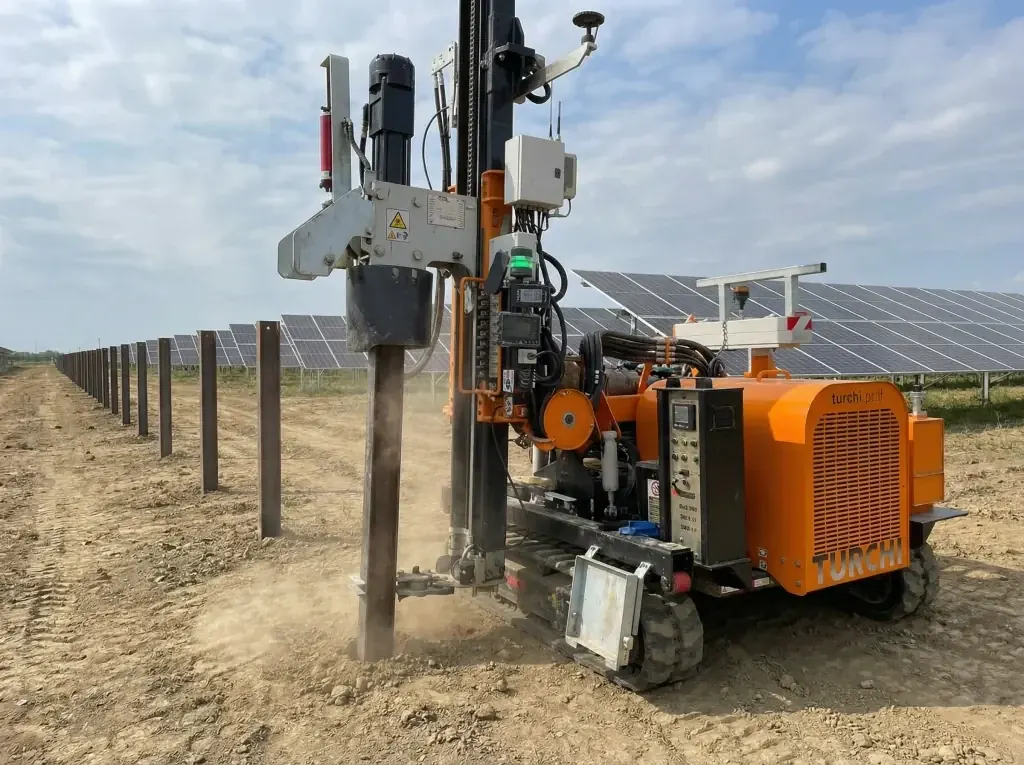
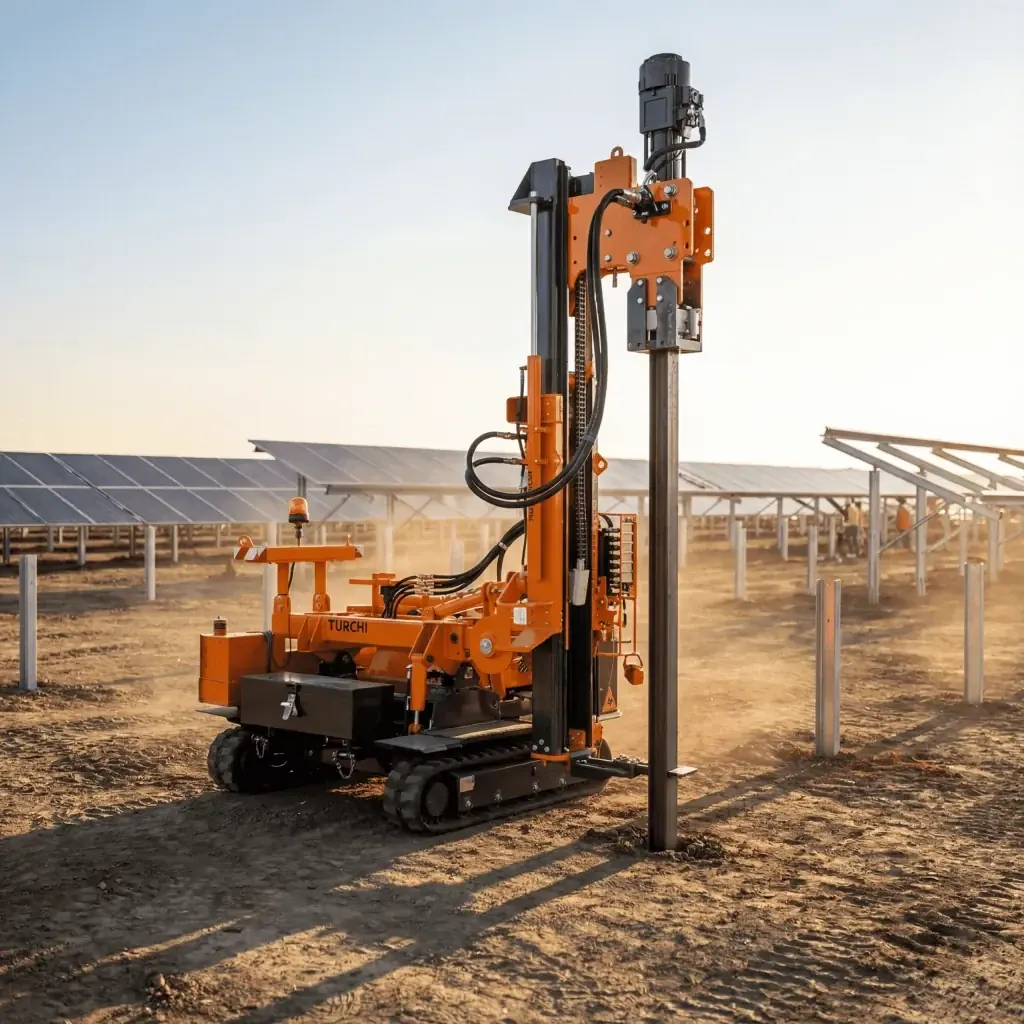
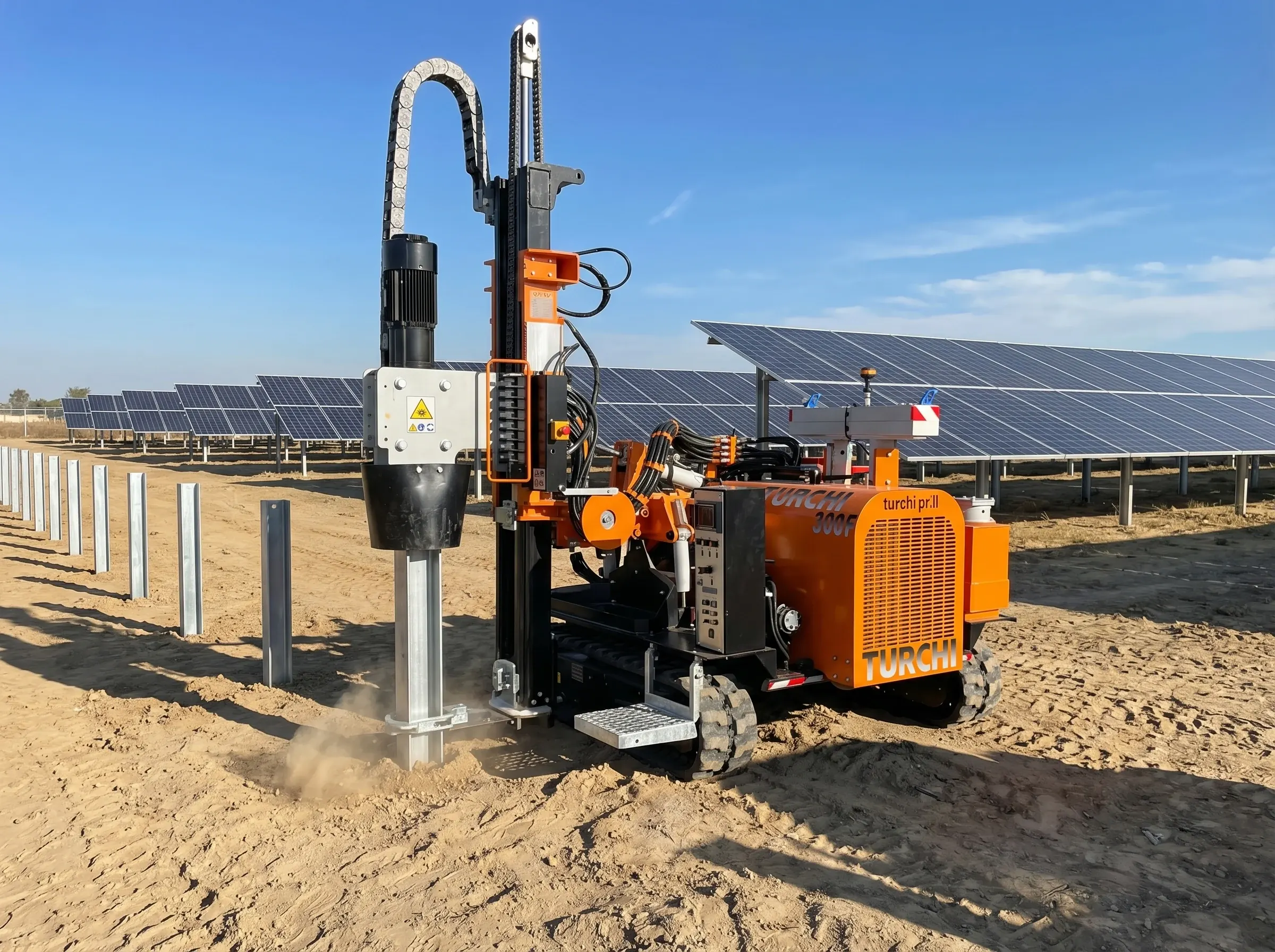
The self-propelled hydraulic pile driver is the reference technology for pile installation. The TURCHI 300F is an autonomous tracked pile driver that moves itself across the construction site without a support excavator: a single operator positions the machine, aligns the pile, and drives. The result is millimeter-accurate, repeatable installation, with GPS traceability of every pile for structural acceptance.
The choice of pile profile is equally important. C profile (more economical, for light trackers), H profile (for heavy structures and difficult soils), tubular (for high-load single-axis trackers). TURCHI manufactures custom mandrels on request for any profile, eliminating the compromises other manufacturers impose with limited ranges.
2026 build timeline and cost per installed MW
Anyone designing a solar farm needs clarity on two numbers: the cost per installed MW and the construction timeline. In 2026 the reference values for a well-designed utility-scale installation are:
| Item | Range €/MW 2026 | Note |
|---|---|---|
| PV modules (Tier 1) | 280-360,000 | 600 W mono-PERC |
| Racking (fixed/tracker) | 70-140,000 | Tracker +70-100% |
| Piles and driving | 35-55,000 | 350-450 piles/MW |
| Inverters + electrical BoS | 90-140,000 | String or central |
| HV interconnection | 40-130,000 | Varies with substation distance |
| Permitting and design | 35-80,000 | Timeline 12-36 months |
| Construction management | 40-80,000 | CM, safety |
Indicative total 2026: 600,000-950,000 €/MW turnkey, land excluded. Values updated to Q1 2026 — fluctuations of 10-15% are normal depending on size, location, and supply conditions.
Effective construction timeline (excluding permitting) for a 1 MW solar farm is typically 6-10 weeks: 2 weeks site prep, 3 days pile driving with TURCHI 300F, 2-3 weeks racking and module installation, 2-3 weeks cabling, commissioning, and testing. For 10 MW projects the time factor scales linearly on piles (30 days) and sub-linearly on modules and cabling thanks to parallel crews.
How to choose the right pile driver for your solar farm
Pile driver selection is the most important operational decision for the foundation phase. Four parameters guide the choice:
1. Project size and required productivity
For projects above 1 MW you need a self-propelled machine capable of driving 100-200 piles/day. Below 500 kW an excavator attachment may still make sense. The TURCHI 300F is designed for the 500 kW-50 MW range with average productivity of 150 piles/day.
2. Pile profile
Single-axis trackers require large-diameter tubular piles (Ø 114 mm and above). Fixed-tilt structures typically use C or H profile. The pile driver must accept custom mandrels for the chosen profile — TURCHI delivers custom mandrels on request for any profile in 2-3 weeks.
3. Soil characteristics
Soft clay soils allow fast driving at reduced energy. Compacted soils, gravel, or rocky strata require higher impact energy (830 J and above) and sometimes controlled pre-drilling. A geotechnical evaluation before construction is always recommended.
4. Purchase, certified used, or rental?
Whoever installs more than 10 MW/year benefits from purchasing: the TURCHI 300F pays for itself in 10-14 months at typical volumes. Below 5 MW/year, certified used is the optimal choice. Turchi SRL is the manufacturer and does not rent directly — for rental solutions, authorized dealers are available across Europe and key international markets.
To explore the selection criteria of a self-propelled hydraulic pile driver in depth, consult our pillar guide: Hydraulic pile driver — guide 2026
ITC, IRA, and solar incentives in 2026
The international landscape for solar farm incentives in 2026 is favorable. Three categories of measures can be combined and should be leveraged in the right order:
**Investment Tax Credit (ITC) and Inflation Reduction Act (IRA).** In the US, the IRA confirmed the 30% Investment Tax Credit for solar projects through 2032, with bonus adders for domestic content (+10%), energy communities (+10%), and low-income areas (+10-20%). The cumulative ITC can exceed 50% of project cost on qualified projects.
**EU Innovation Fund and EEAG-compliant national schemes.** In Europe, the Innovation Fund finances large-scale projects integrating solar with storage. National schemes (German EEG, Italian FER, Spanish RD, Polish auctions) offer 15-20 year guaranteed prices through competitive auctions.
**Accelerated depreciation (MACRS, Section 179, IT iperammortamento).** Most jurisdictions offer accelerated depreciation for renewable energy equipment. In the US, MACRS plus bonus depreciation can recover most of project capex in 5 years. The pile driver itself qualifies as Industry 4.0 equipment in some jurisdictions for additional bonus depreciation.
The right approach is to talk to a tax advisor specialized in renewable energy incentives before placing orders: some measures require pre-construction certification, others have minimum holding periods of 3-5 years.
Case study: 1 MW solar farm in 3 days with TURCHI 300F
An average 1 MW project requires typically 400 driven piles for fixed-tilt structures. With a conventional excavator-mounted attachment the pile-driving phase takes 6-8 working days: one operator on the pile driver plus an excavator operator, with productivity of 50-60 piles/day and frequent stops for repositioning.
With a TURCHI 300F the same site closes in 3 working days with a single operator. The tracked machine moves itself along the path, the boom positions the pile automatically, the hydraulic hammer drives at controlled energy, GPS records the coordinates of each pile for acceptance. Average productivity: 130-150 piles/day, peaking at 200 in homogeneous soil.
The economic benefit is measurable. Direct savings: 3-5 person-days of construction (operator + excavator operator), excavator rental zeroed out, simplified site logistics. Indirect savings: pull-forward of commissioning timeline (2-3 weeks gained on the overall schedule), reduced weather risk exposure, higher driving quality documented with GPS traceability.
On a 10 MW solar farm — which would require 60 days with traditional solutions — a TURCHI 300F closes pile driving in 30 effective days. That's 30 days less construction, typically a fiscal quarter pulled forward for project commissioning.
Want to estimate your project's timeline and costs?
Send us your project size, planned pile profile, and location: detailed technical response within 12 hours.
Frequently asked questions about solar farms
It depends on the structure type. Fixed-tilt structures typically require 350-450 piles per MW. Single-axis trackers require up to 600 piles/MW because of higher support point density. The exact density depends on module size (400 W vs 600 W), string orientation, and design snow/wind loads.
The 2026 turnkey cost for an industrial solar farm is typically 600,000-950,000 €/MW, land excluded. Variability depends on distance to interconnection, soil type, choice between fixed-tilt and trackers, and project size (economies of scale appear above 5 MW).
Pile driving is the dominant choice in 90% of solar farms because it eliminates 7-28 days of concrete cure time, requires no formwork or masonry crews, generates zero construction waste, and works in variable weather. Concrete only makes sense in non-driveable soils (continuous surface bedrock) or under specific environmental constraints.
Yes, the TURCHI 300F meets all technical requirements for solar farm projects under most international incentive frameworks (US ITC, IRA, EU schemes). The GPS pile-tracking feature provides documentation needed for structural acceptance and reporting to managing authorities, and is compatible with most tracker manufacturers (Soltec, Nclave, PV Hardware, Trina Tracker, ATI, Nextracker).
Permitting timelines vary widely by jurisdiction. In the US, typical timelines are 12-36 months including interconnection studies. In Europe, simplified procedures can complete in 6-18 months for projects under 1 MW; full procedures with environmental impact studies typically take 18-36 months for utility-scale projects. Some regions and states offer accelerated procedures for projects on previously developed land.
Yes, with constraints. Most jurisdictions allow solar farms on agricultural land in two modes: conventional ground-mount with size limits and setback requirements, or agrivoltaic installations with continued cultivation under the panels. Agrivoltaic installations benefit from accelerated permitting and specific incentives in many jurisdictions.
A well-oriented fixed-tilt solar farm produces 1,300-1,800 MWh/year per installed MW depending on latitude (lower at higher latitudes, higher in southern Europe and the southern US). With single-axis trackers production increases by 15-25%. The PR (Performance Ratio) of a new well-designed installation is typically 82-88%.
TURCHI Daniele SRL has been an Italian manufacturer since 1973 and designs pile drivers entirely at its Pilastro (Parma) facility. Three key differentiators: (1) custom mandrels for any pile profile in 2-3 weeks, (2) direct support without intermediaries with spare parts in 48 hours across Europe, (3) detailed technical proposal in 12 hours based on your project data — no 2-year wait list like German competitors.
Let's talk
Your solar farm starts here
Send us your project data: capacity, planned pile profile, project size, location. We respond with a technical proposal + timeline estimate within 12 working hours.
12-hour response · Zero commitment · TURCHI since 1973 Made in Italy