Solar pile driver: how to choose the right machine
A 1 MW solar plant often requires 350-450 piles, but the total depends on the structure. The pile driver and site organisation affect the schedule, labour and cost per pile.
Choose it badly and you are not dealing with a minor technical detail; you are burning margin.
The role of the pile driver in solar installation
A 1 MW plant often requires 350-450 foundation piles, but one two-pile support project needed about 1,000. H, C, U or Sigma steel profiles support the mounting structures; the count depends on the structure and design, not capacity alone. Ballasted structures require a different calculation.
The machine that carries out this operation, the self-propelled hydraulic pile driver, is the real production heart of the site. An efficient pile driver can halve lead times, cut labour and reduce the cost per installed pile. An inadequate one creates delays, overspend and quality problems that ripple through the whole project. That is why machine choice is a strategic decision, not just another technical purchase.
Whether you are a solar EPC installer, a general contractor or a plant owner, here are the three main types, the technical criteria to assess and the economic factors that should guide your decision.
Types of pile driver for solar
The market offers three main categories for driving solar piles. Each has advantages and limits depending on the operating context.
Tracked self-propelled pile driver
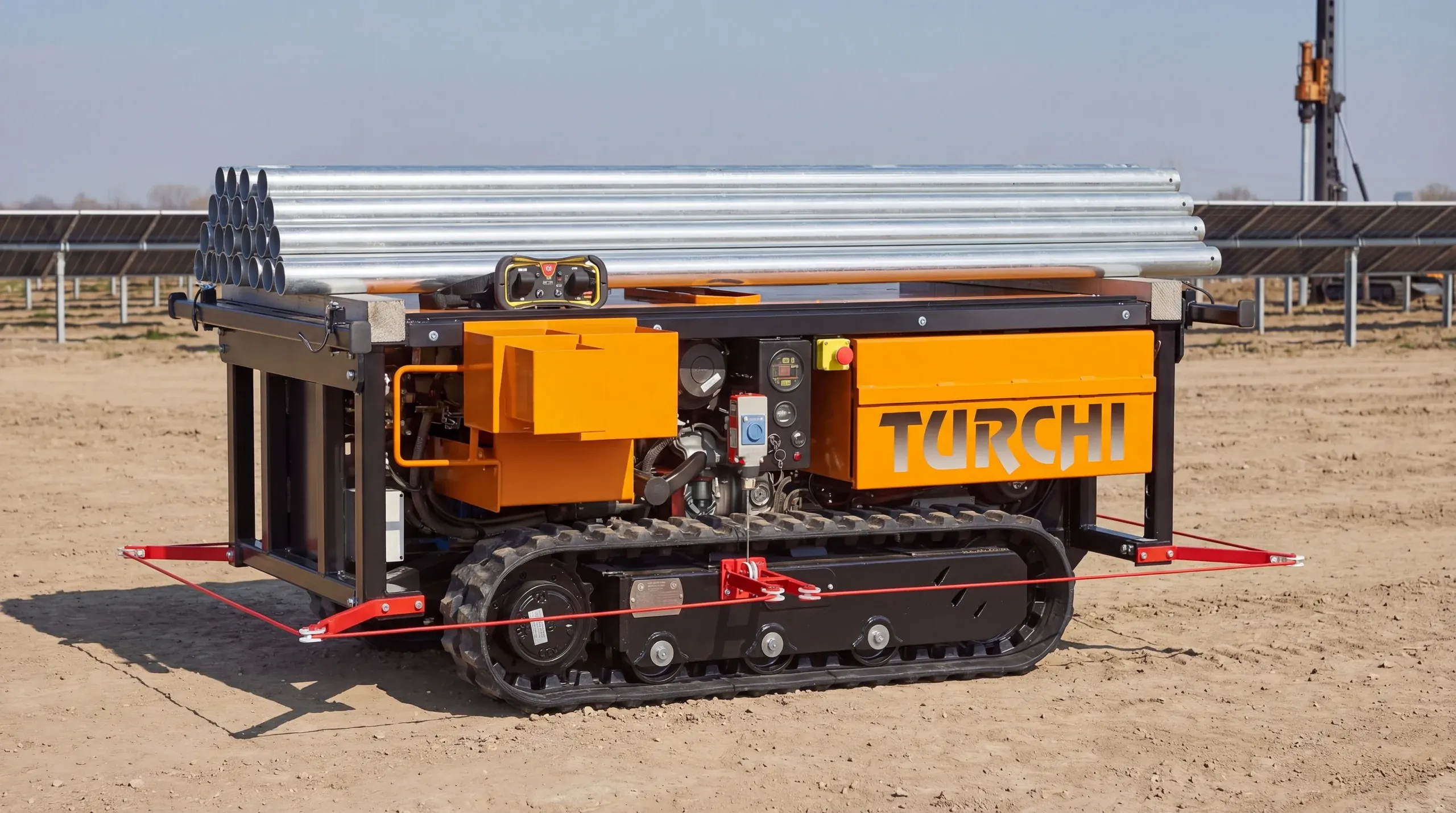
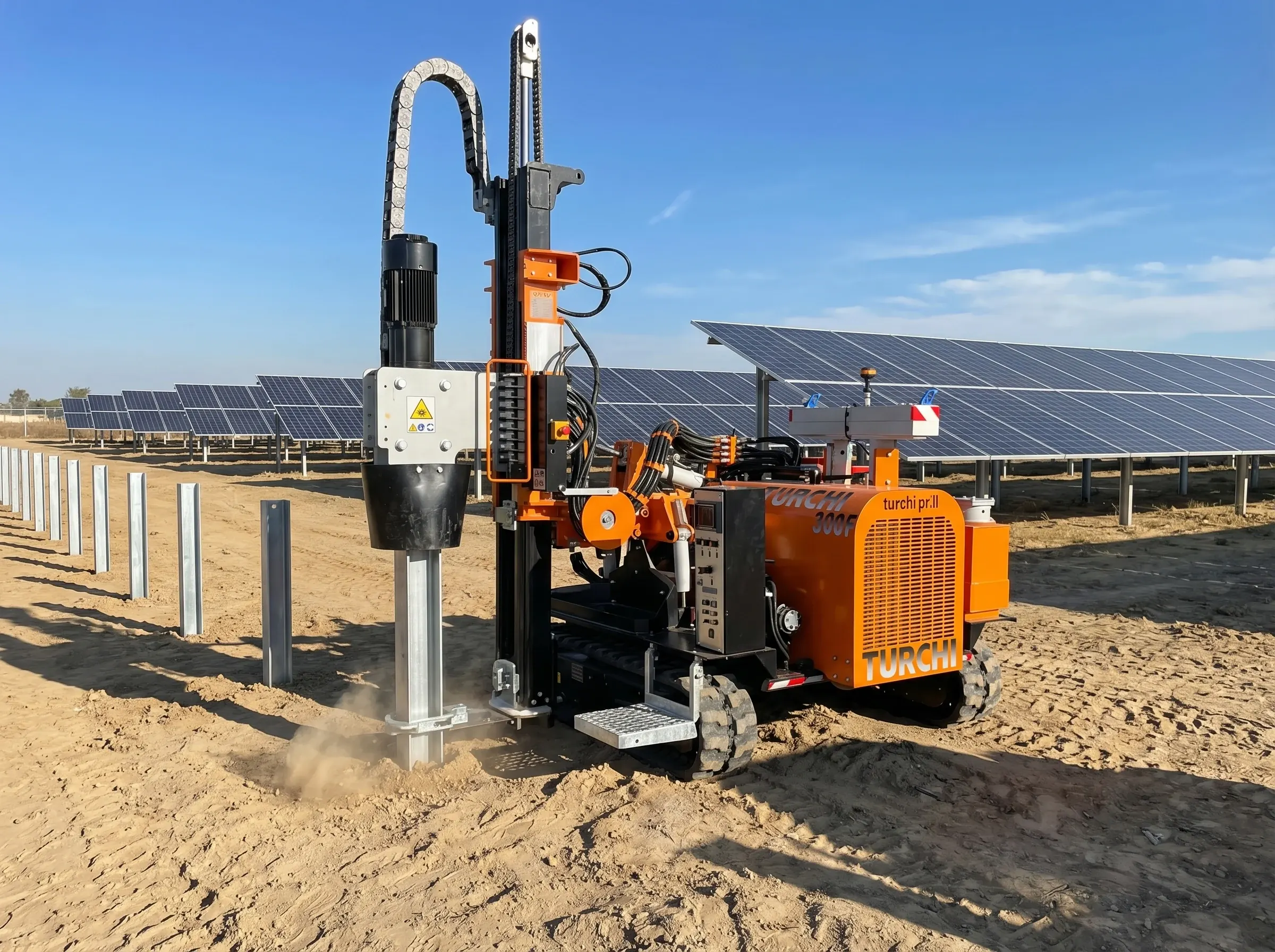
The tracked self-propelled pile driver, such as the TURCHI 300F, is the most advanced solution for solar. It is a complete, autonomous machine: it moves on its own, loads piles, positions them and drives them. One operator controls the machine; handling long piles may also require an assistant and lifting equipment.
Advantages: tracked mobility and simple logistics. With short piles, 150 piles per day is an indicative average for the 300F; 200-300 are possible in optimal conditions. Actual output depends on the site and crew. Disadvantages: higher initial cost and the need for a low-loader for road moves. On sites with large volumes (over 2,000 piles) the self-propelled machine is almost always the most economical choice in cost per pile terms.
Pile driver mounted on an excavator
This is equipment (vibratory or impact hammer) fitted to the boom of an existing excavator. The advantage is versatility: if you already own an excavator, the initial investment is lower. But it requires an experienced operator, delivers lower productivity (typically 60-80 piles/day), needs a second vehicle for pile supply and ties up the excavator on this task, taking it away from other work. On large volumes total cost quickly exceeds that of a self-propelled machine.
Truck-mounted pile driver
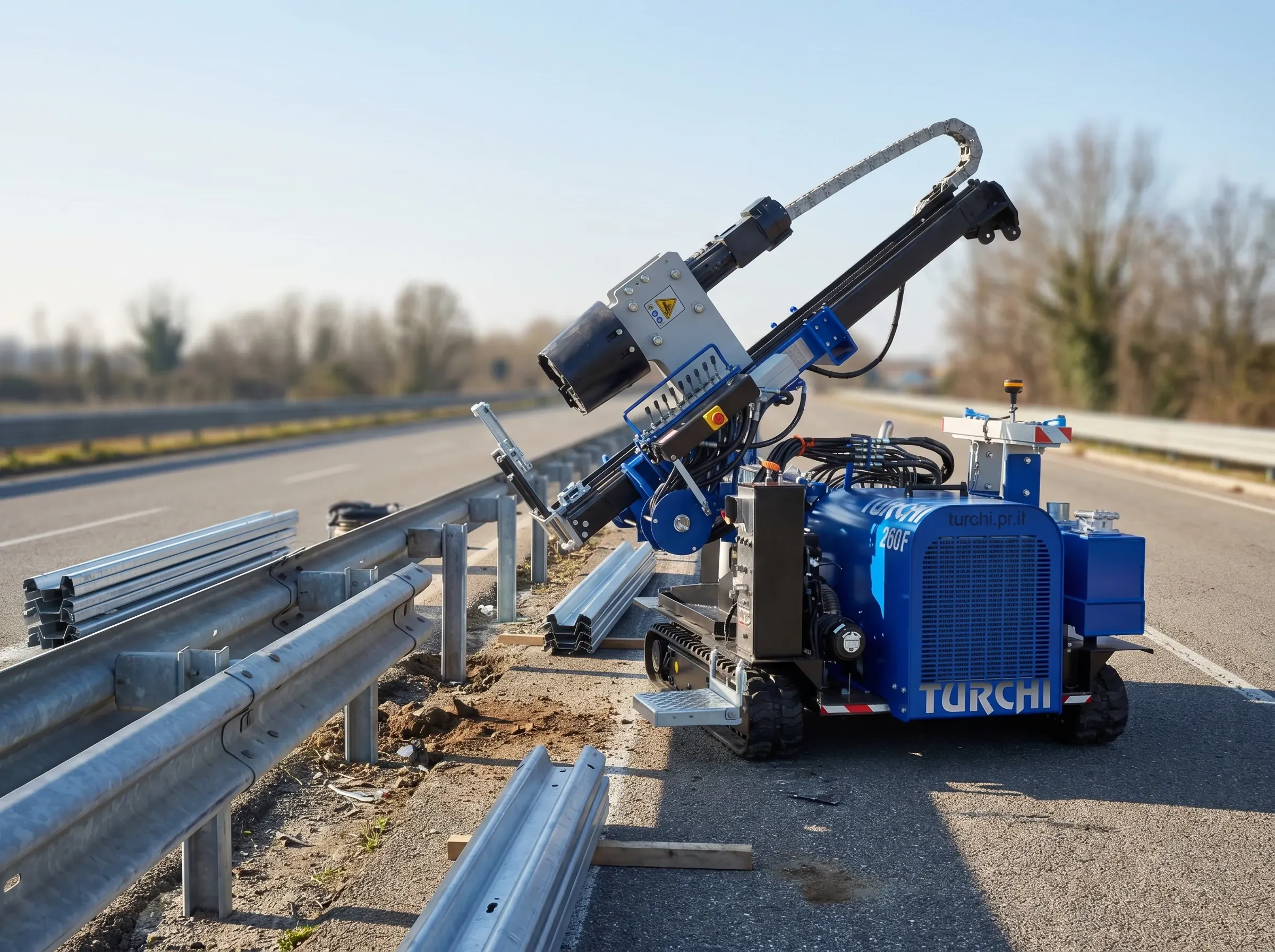
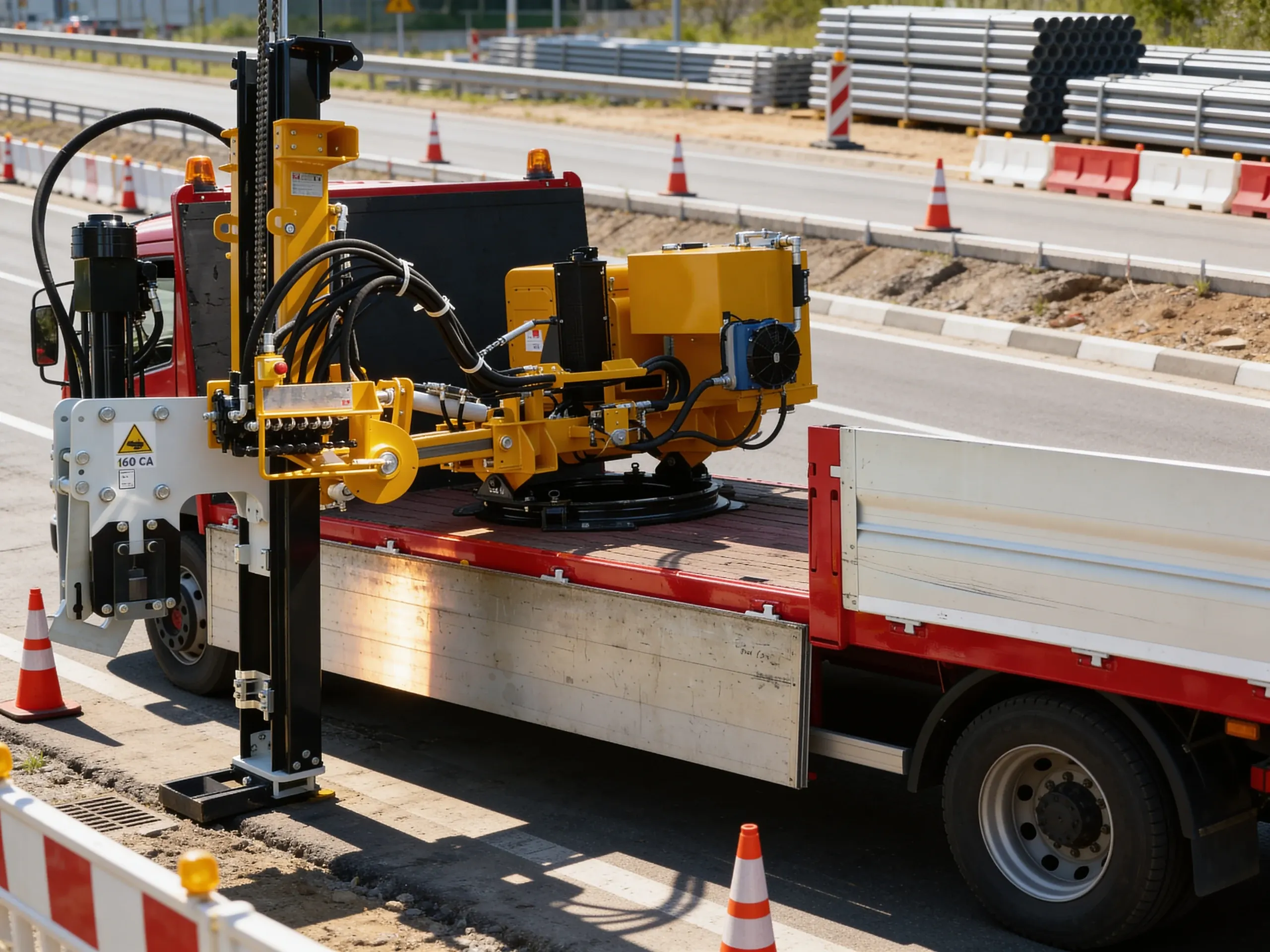
It offers road mobility: you move between sites without a low-loader. It is common in guardrail and fencing, less so in solar. Limits in solar are poor mobility on unprepared ground, the need for a dedicated truck and moderate productivity. On agricultural land the truck’s limited manoeuvrability is often a serious problem.
Selection criteria: what to assess
The choice depends on five technical factors every site manager should evaluate before buying or hiring.
Impact energy (Joule)
There is no minimum impact energy in Joule suitable for every solar pile. Hammer selection requires pile profile and height, design depth and ground resistance. Compact ground may require pre-drilling; increasing energy alone does not guarantee output. Compare hammer specifications with pile data and geotechnical tests.
Working height
Working height determines the maximum pile length you can drive. For solar, the most common heights are 3-4 metres on standard plants and 4-6 metres on trackers and elevated arrays. TURCHI machines offer configurable heights from 3,5 m with the TURCHI 260F up to 6 m with the TURCHI 300F.
Real productivity (piles/day)
Be wary of “laboratory” figures. Real productivity depends on ground conditions, pile logistics, drive depth, weather and operator skill. Always ask for verifiable site data, not theoretical specifications. With short piles, 150 piles per day with the TURCHI 300F is an indicative average, not a minimum or maximum; 200-300 piles are possible in optimal conditions.
Automation and technology
Modern machines can be fitted with optional assistance systems that increase productivity and quality: semi-automatic GPS/GNSS to position the pile on the design layout, electronic verticality assistance for alignment, remote monitoring to supervise the machine from the office. On sites with thousands of piles they measurably reduce errors, rework and downtime. Solar is the sector that benefits most.
Ground conditions make the difference
Ground type is the most influential factor in machine choice and productivity. A preliminary geotechnical assessment is always recommended, especially on large plants.
Normal and sandy soils
On sandy, silty or gravelly soils driving is direct and fast: ideal conditions for any pile driver, with maximum productivity. The only concern is long-term pile holding capacity: on very sandy soils greater depth may be needed to guarantee structural stability.
Clay soils
Clay requires hammer energy and actual depth to be assessed using ground tests and pile data. It can cause “set-up”: pull-out resistance changes over time after driving. In wet periods saturated clay can compromise machine stability: the self-propelled machine’s wide tracks offer a decisive advantage over truck wheels.
Rocky ground
On rock, direct driving is not possible. The solution is pre-drilling with a pneumatic drill (DTH), followed by driving the pile into the prepared hole. It reduces productivity but is the only alternative to concrete foundations, which are far more expensive. TURCHI machines can mount the pneumatic DTH as an integrated accessory, keeping the whole process on a single machine.
Hire or purchase: when each option pays
The most frequent question is whether hire or purchase is more cost-effective, and the answer depends on annual workload. Indicative hot-hire cost (machine plus operator) in Italy starts at around €1,000/day and varies by region, machine and season.
Considering a quality self-propelled pile driver, depreciable under current tax rules, the breakeven typically falls at around 40-60 days of use per year. Beyond 60 days purchase is almost certainly more economical, and it makes you independent of hire company availability, which in peak periods can be a serious problem. For the detailed calculation, read how many MW you need to pay off a pile driver: purchase vs hire.
Why the self-propelled machine is dominating the market
Over the past five years the tracked self-propelled pile driver has gained growing share in solar, at the expense of excavator and truck mounts. The reasons are clear: one operator instead of 3-4 people, no dependence on cranes or support vehicles, setup in minutes rather than hours, mobility on any ground thanks to tracks, and steady, measurable productivity.
With short piles, 150 piles per day with a TURCHI 300F is an indicative average; 200-300 piles are possible in optimal conditions. For 1 MW, 350-450 piles are common, but a two-pile support design may require many more. Pile height, ground, handling and crew determine the days needed: plant capacity alone cannot establish them.
To find the ideal configuration for your site, start with the 7-step configurator and receive a personalised quote.
Frequently asked questions
Can't find what you're looking for? Browse the full FAQ list. Reach out via a support request or email us at [email protected].
The TURCHI 300F is the first machine to consider, configurable for piles up to 6 metres; the 260F may suit shorter piles and narrow access. The choice depends on pile height, ground and logistics, not plant capacity alone. The machine alone cannot guarantee daily output.
For the TURCHI 300F with short piles, 150 piles per day is an indicative average, not a guaranteed minimum. In optimal conditions, 200-300 piles are possible; long piles or difficult ground reduce output. Pile height, handling and crew are essential to estimate your site's productivity.
If you use the pile driver for more than 40-60 days a year, purchase is almost always more cost-effective. For a detailed analysis, read our dedicated article on ROI.
There is no minimum Joule value suitable for every solar pile. Hammer selection depends on profile, length, depth and ground resistance; difficult ground may also require pre-drilling. Send us the pile and ground data to size the equipment.