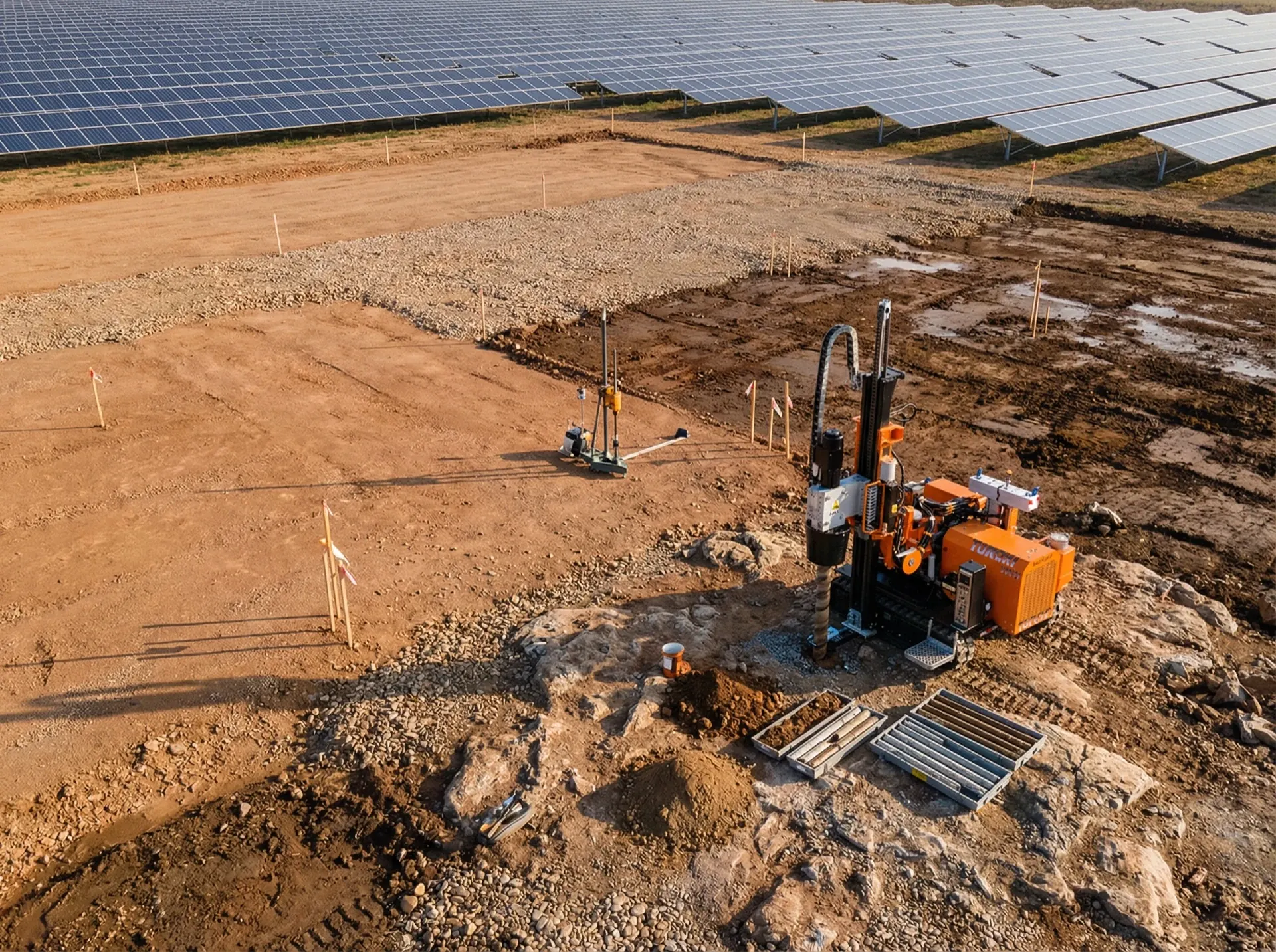
Solar site ground: geotechnical assessment guide
The success of a ground-mounted solar plant starts long before the pile driver arrives on site. It starts with ground assessment. This phase is often undervalued to save time and budget, but it is the foundation of the entire project.
Poorly characterised ground creates costly surprises: piles that do not reach design depth, unstable foundations to correct, delays that blow schedules and trigger penalties.
Here is how to assess the ground, which tests to run and how soil characteristics determine machine and driving system choice.
Solar ground: 5 requirements to check first
Before detailed geotechnical analysis, five macro requirements indicate whether the project is feasible.
Slope
The maximum acceptable slope for a ground-mounted plant with driven piles is generally 10-15%, depending on structural technology. Beyond that threshold levelling pushes costs up sharply. Single-axis trackers need flatter ground, with a maximum 5-8% north-south slope.
Absence of landscape and environmental constraints
Always check landscape constraints (Legislative Decree 42/2004), protected areas (SCI, SPA, parks), hydrogeological constraints and landslide or flood risk zones (PAI). These checks are mandatory: constrained land can make the project unviable or greatly extend the permitting process.
Proximity to the electricity grid
Grid connection is a cost often underestimated. Every metre of cable between plant and connection point weighs on the budget. Land close to MV/HV primary substations or existing lines is preferable. Check available capacity on the local network with the operator (e-distribuzione or Terna).
Plant access
Pile driver, pile cart, material trucks and mounting cranes must be able to reach the site. Check access road width (minimum 3,5 m), load capacity of bridges and underpasses along the route, manoeuvring space on site and ground bearing under vehicle traffic, especially in wet weather.
Absence of shallow rock
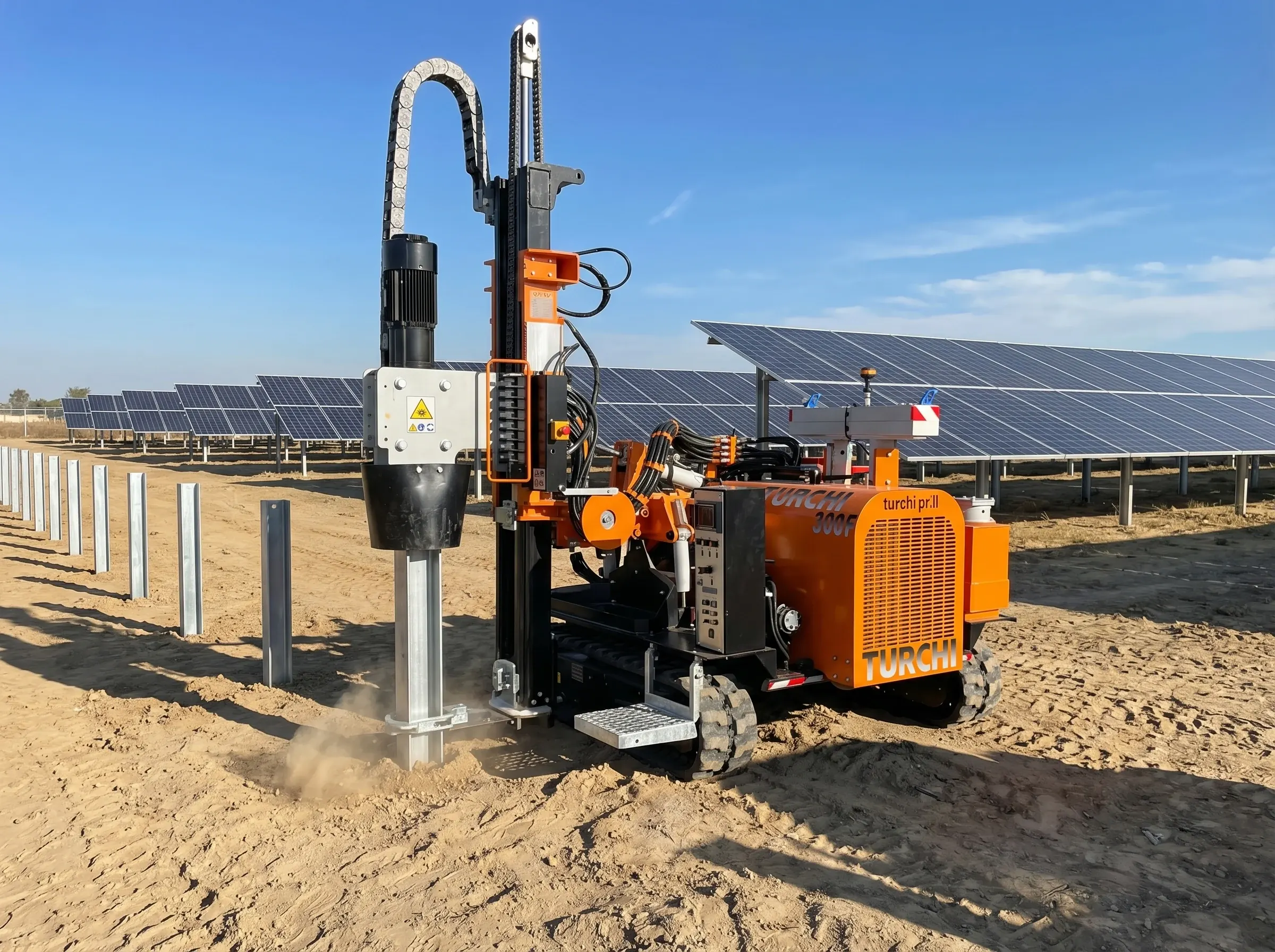
Rock within 1,5-2 m of the surface is the most common geotechnical problem in solar. It does not rule out driven piles, but it requires pneumatic DTH pre-drilling, with more time and cost. TURCHI machines mount pneumatic DTH as an integrated accessory on the machine, so you handle these situations without a second machine.
Ground types and impact on driving
Ground type is the factor that most determines machine and driving system choice.
Sand and gravel
These soils can favour direct driving. With short piles, 150 piles per day is an indicative average, not a maximum: in optimal conditions 200-300 can be reached. Handling and crew also matter. Lateral holding capacity must be checked: on very fine or unconsolidated sands greater depth may be needed for stability. Pull-out tests are recommended to verify capacity.
Clay
Clay has variable resistance, closely linked to water content. Dry, compact clay requires high impact energy (1,000+ Joule). Wet clay penetrates more easily but can destabilise the machine, where the self-propelled machine’s wide tracks are a clear advantage. Watch for set-up: clay can grip the pile after driving, increasing holding capacity over time but making extraction difficult. Expected productivity: 60-100 piles/day, well below sandy soils.
Rock
When boreholes find rock layers within design depth (usually 1,5-3 m), direct driving is not possible. The solution is pre-drilling with down-the-hole (DTH) drilling, which creates a pilot hole in the rock where the pile is then inserted and grouted or driven. TURCHI machines mount pneumatic DTH directly on the machine, without a dedicated second machine. On rock productivity is estimated at 30-60 piles/day, depending on layer hardness and pre-drill diameter.
Mixed ground
This is the most common and the most treacherous situation. Alternating layers of sand, clay, gravel and sometimes rock make productivity variable and unpredictable. Managing it requires geotechnical assessment with boreholes at multiple points, a pile driver with energy in reserve for resistant layers, DTH available for rock layers and an experienced operator who adapts technique as ground varies.
Required geotechnical tests
Several tests are needed to characterise solar site ground properly.
The Standard Penetration Test (SPT) is the most common: a sampler is driven with standardised blows and the number of blows to penetrate 30 cm (NSPT value) indicates soil consistency.
| NSPT | Consistency | Driving |
|---|---|---|
| < 10 | Soft soil | Easy |
| 10-30 | Medium soil | Normal |
| 30-50 | Hard soil | Difficult, high energy |
| > 50 | Refusal or rock | Pre-drilling required |
These are standard geotechnical references: for classification of your ground always rely on a geologist or geotechnical engineer. Cone penetration tests (CPT) give a continuous resistance profile, more detailed than SPT. Core drilling takes physical samples for the laboratory and is used when rock layers or problematic soils are suspected.
For solar sites the minimum recommended number of boreholes is 1 every 2-3 hectares on homogeneous sites, 1 per hectare on sites with variable geology. Cost, from a few thousand up to €10-15,000 on large sites, is a tiny fraction of the budget and prevents far costlier surprises on site.
From ground to solution: decision table
Quick guide linking ground type to the most suitable TURCHI machine.
| Ground (NSPT) | TURCHI solution |
|---|---|
| Sand and gravel (< 15) | Direct driving with any model, no special accessory |
| Medium clay (15-30) | Direct driving with TURCHI 260F or 300F, minimum 1,000 J energy |
| Hard clay (30-50) | TURCHI 300F at 1,500 J, possible partial pre-drilling |
| Rock (> 50) | TURCHI 300F with integrated pneumatic DTH, pre-drilling mandatory |
| Mixed ground | TURCHI 300F with DTH available, maximum flexibility |
For a configuration based on your ground, start with the 7-step configurator or read the solar pile driver buying guide. To understand how many piles you can realistically drive per day on your soil, see also how many piles per day a pile driver delivers.
Regulatory constraints in Italy
Beyond geotechnics, solar ground in Italy must comply with several regulatory constraints. Protected areas (national and regional parks, reserves, Natura 2000 sites) are generally excluded or require specific environmental assessments (EIA, screening). PDO and PGI zones may have land-use restrictions that limit or prevent plants. Minimum distances from settlements, roads, railways, power lines and watercourses vary by region and municipality. The municipal master plan and implementation technical standards (NTA) set permitted land uses.
The Suitable Areas Decree (Ministerial Decree 2024) introduced national criteria for identifying land suitable for renewable energy plants, which each region is adopting through its own resolutions. Check all these constraints before buying land or designing the plant, so you do not spend on geotechnical surveys on sites that can never host it.
Frequently asked questions
Can't find what you're looking for? Browse the full FAQ list. Reach out via a support request or email us at [email protected].
The main tests are SPT (Standard Penetration Test) and cone penetration tests (CPT). On sites with suspected rock, core drilling is also required. At least one borehole every 2-3 hectares is recommended.
Yes, with pre-drilling via pneumatic DTH. TURCHI machines can mount integrated DTH, handling the whole process on a single machine.
Cost ranges from a few thousand to €10-15,000 on large sites, a tiny fraction of the total project budget. It is an investment that prevents far costlier problems on site.
Protected areas (Natura 2000, parks), PDO/PGI zones, landscape constraints (Legislative Decree 42/2004), hydrogeological constraints and local planning rules. The 2024 Suitable Areas Decree introduces further criteria.