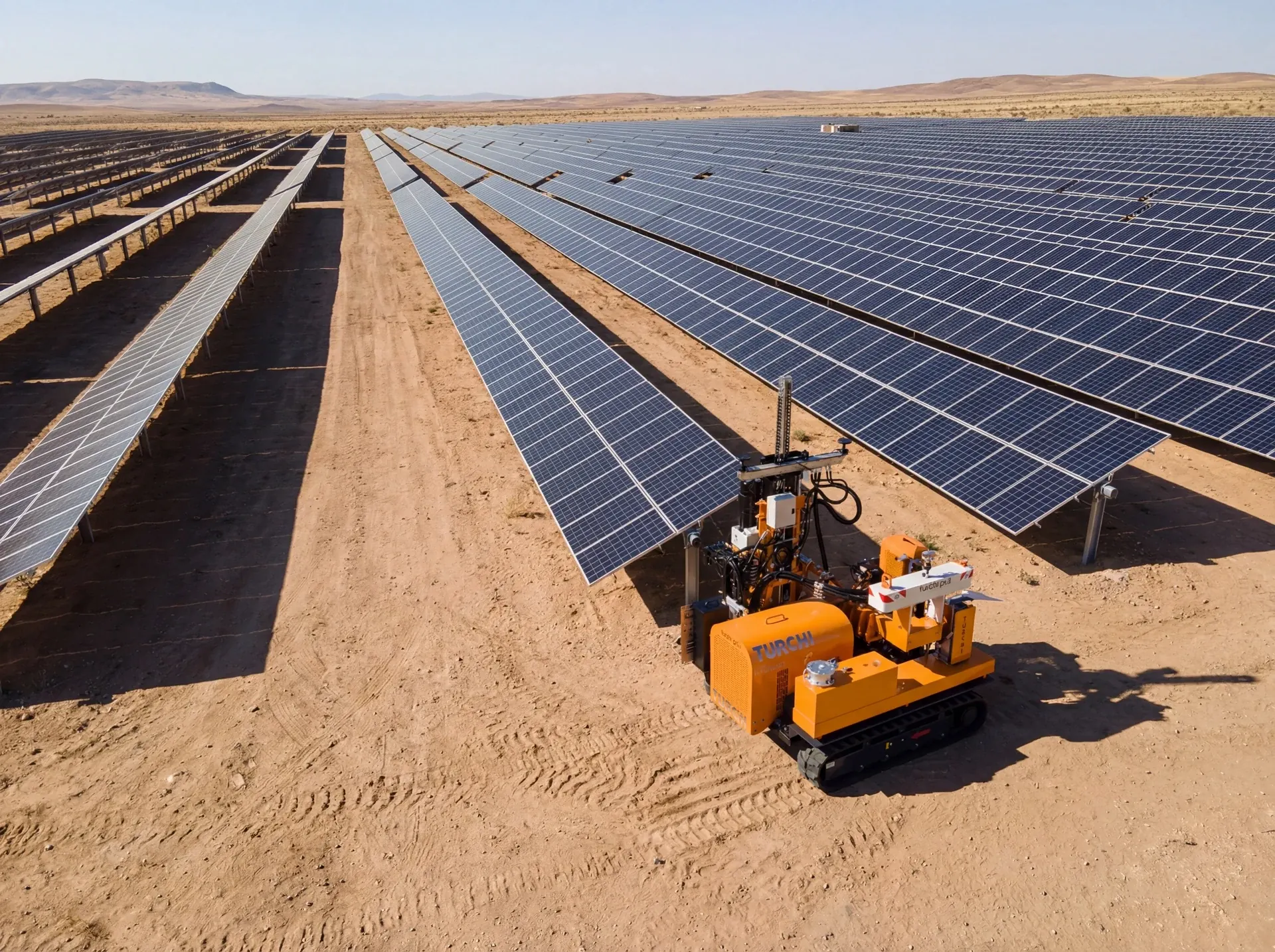
1 MW or 20 MW plant? For the pile driver, only one thing changes
Anyone starting with a few MW of solar will sooner or later face larger projects, 15, 20 MW and beyond, and ask a legitimate question: will the machine I use today hold up on sites of that scale, or will I need different equipment?
Short answer: yes, it will. Understanding why helps you plan better and avoids two opposite mistakes: underestimating the time for a large field, or being promised at the desk a productivity figure that no serious supplier can guarantee without having seen the ground.
“1 MW or 20 MW plant” does not change the machine, it changes the number of piles
You might assume a larger plant needs a more powerful machine. For pile drivers it does not work that way, and the reason is simple: a pile driver does not work on the plant, it works on each individual pile.
The machine repeats the same cycle (position, drive a pile, move to the next) on a 1 or 20 MW field. Total size does not change the individual technical operation; the number of piles and days required change.
It is like a screwdriver: it does not matter whether you are fitting one bookshelf or an entire bedroom, the drill is the same. Only how many hours you spend on it changes.
How many piles we are really talking about
For a 1 MW solar plant, 350-450 piles are a common order of magnitude, not a fixed conversion. The structure affects the count: one two-pile support project required about 1,000 piles per MW. For 20 or 100 MW, use the project’s structural drawings, not a standard number multiplied by capacity.
On a large plant you are not doing a few hundred extra piles: you are managing tens of thousands of drives. That is where site organisation decides whether you meet the deadline or pay penalties.
Pile, height and ground: which configuration is needed
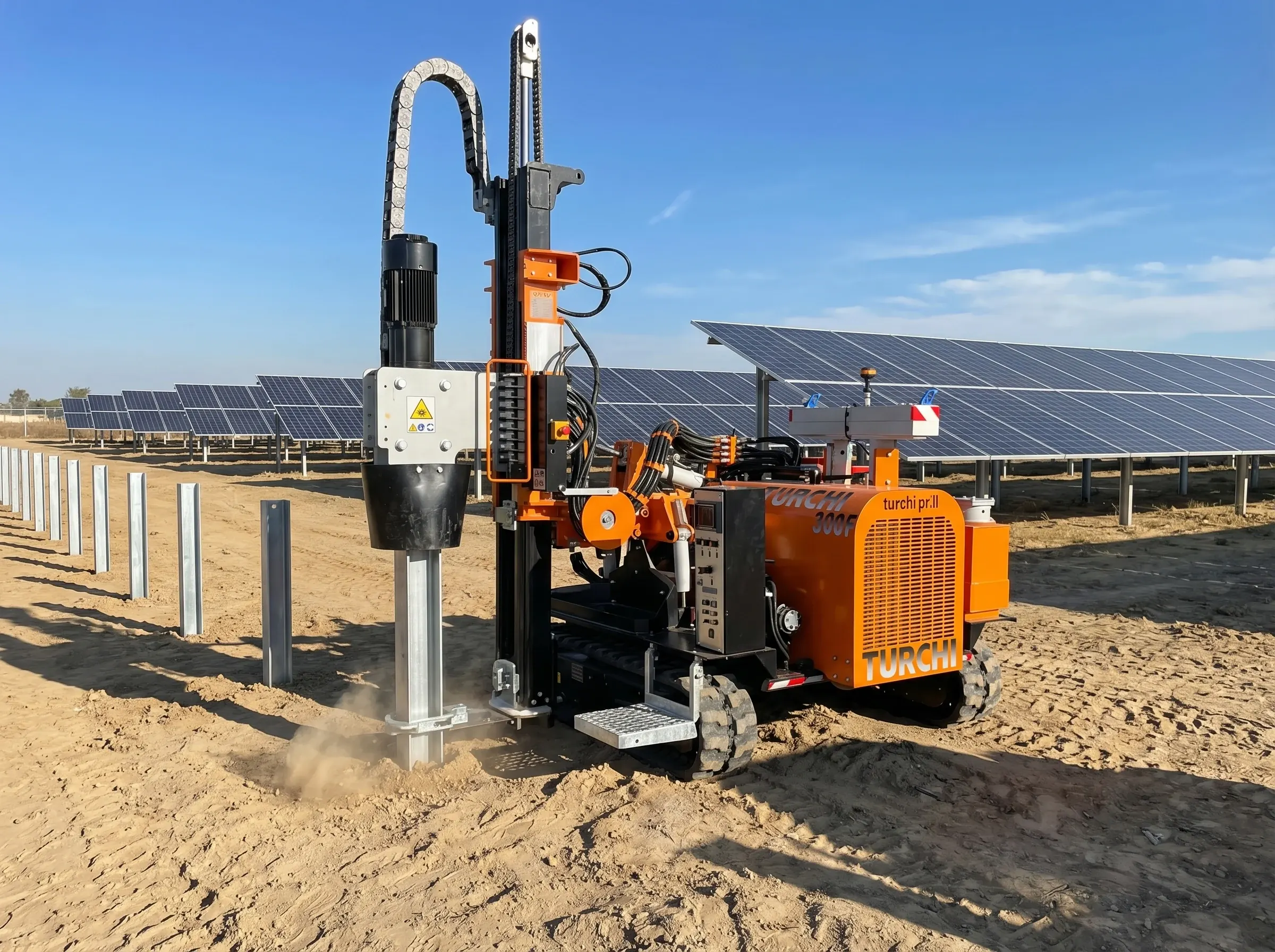
A large plant can have different geometries and pile profiles. Setting up the TURCHI 300F requires the pile’s technical drawing or dimensions: the upper guide and lower pile centring device are prepared for that profile. Height determines the column; the 300F reaches 6 m with the appropriate configuration.
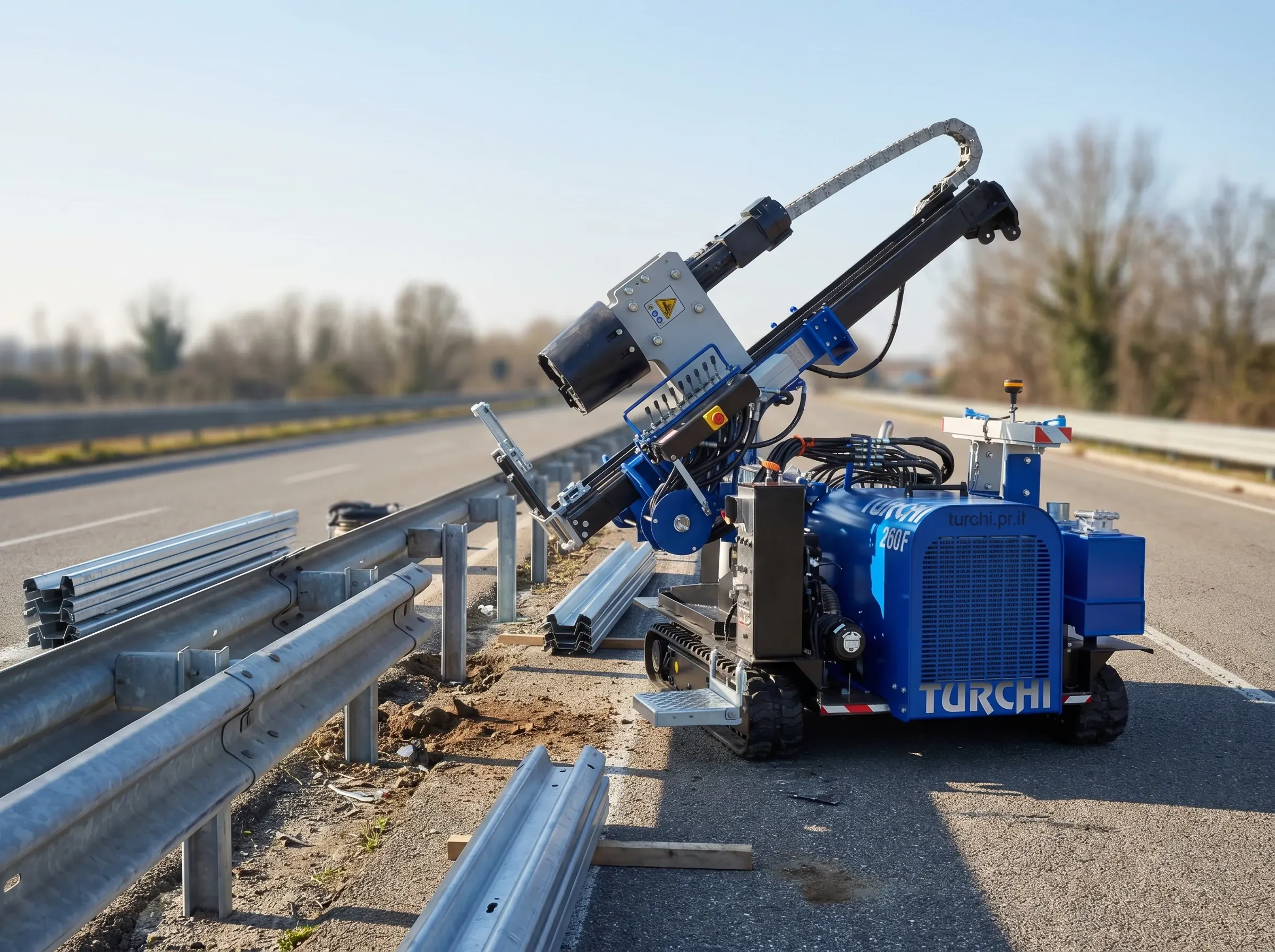
Ground conditions need a separate assessment. If pre-drilling is required, 300F and 260F can carry dedicated equipment; tool, diameter and depth depend on subsoil and project. Pre-drilling affects the schedule and requires the appropriate tool to be fitted. No promise can be made that it needs no equipment change or that one diameter suits every site.
How many piles per day? The honest answer is: it depends
It is the question everyone asks, and the correct answer is exactly the one you should distrust when it is given as a fixed number: it depends, and it depends on quite a lot.
Real productivity can range from roughly 200 piles per day down to around twenty, depending on:
- pile type and height (taller piles, more time);
- ground and subsoil (hard ground means pre-drilling, and the rate drops);
- number and experience of operators;
- working conditions (weather, logistics, site organisation).
Anyone who promises “X piles per day guaranteed” without looking at your ground and your piles is selling you a number, not data. True productivity is estimated for the specific site. We prefer to be precise upfront rather than make promises the ground disproves later.
What really changes on a large plant: time and number of machines
Once you accept that each pile is always the same job, and that speed depends on conditions, planning a large plant comes down to two levers: site days and the number of pile drivers working in parallel.
If the project’s pile count and deadline require it, deploying several machines at the same time compresses the schedule and helps maintain continuity. If one machine is in maintenance, the site does not stop. You do not need a “bigger” unit, you need more units working together.
The same plant, therefore, can be done with one machine in more time or with three in less time. You decide, based on EPC penalties and cash flow, not the technology. And there is no plant size beyond which the system “cannot cope”: the more MW you grow, the more it pays to increase the number of pile drivers. If the cost reasoning interests you, we have developed it in the guide on how many MW you need to pay off a pile driver.
Why self-propelled makes the difference at scale
Two characteristics separate a site that flows from one that gets stuck:
- Self-propelled means less dead time. The machine moves itself from one pile to the next, without vehicles towing it. Over tens of thousands of piles, every small saving per move multiplies into days across the whole project.
- Pre-drilling when needed. With appropriate options, the machine can prepare holes in difficult ground; the sequence and timing vary with the required tool, depth and diameter.
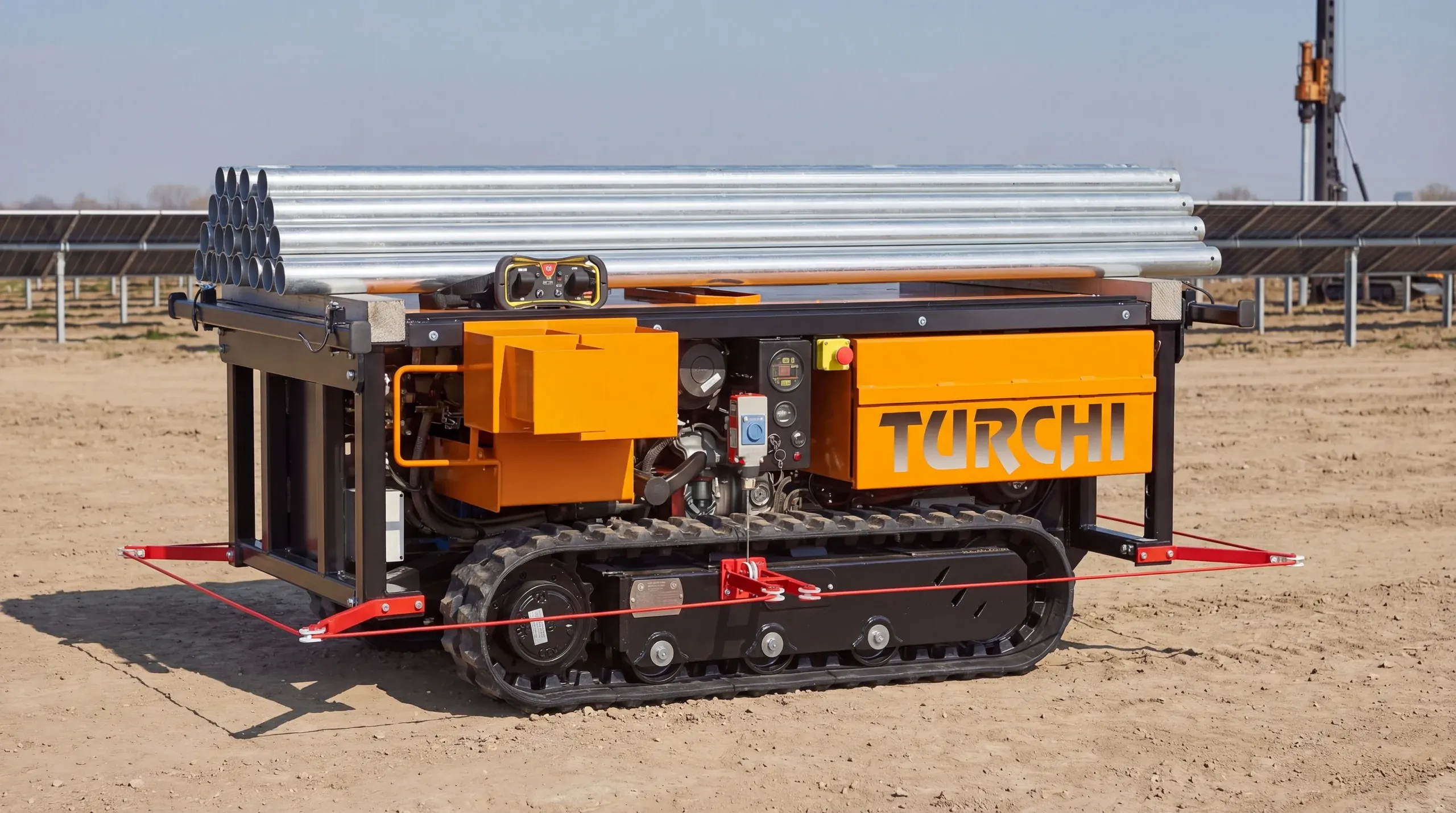
On very large plants, GPS positioning helps bring the machine to design points, but that is a separate topic. The TURCHI 300F is built precisely for these volumes, and the tracked pile carrier keeps the driving cycle fed without stopping the field.
In summary
Capacity in MW alone does not determine pile driver choice. Pile count and height, the profile drawing for the guides, and ground conditions are needed. The TURCHI 300F column reaches 6 m with the appropriate configuration. Output and machine count must be estimated for the site and project deadline.
Want to work out how many machines you need and how many days to close your field? Start from the 7-step configurator to set the estimate for your actual plant.
In this article
- Introduction
- “1 MW or 20 MW plant” does not change the machine, it changes the number of piles
- How many piles we are really talking about
- Pile, height and ground: which configuration is needed
- How many piles per day? The honest answer is: it depends
- What really changes on a large plant: time and number of machines
- Why self-propelled makes the difference at scale
- In summary
Frequently asked questions
Can't find what you're looking for? Browse the full FAQ list. Reach out via a support request or email us at [email protected].
Yes: the pile driver works on individual piles even on large plants. However, the number of piles in a 20 MW plant depends on the structure: a fixed figure per MW cannot simply be multiplied. The number of machines required depends on the project and schedule.
For 1 MW, 350-450 piles are common, but the structure can substantially change the total: one two-pile support project required about 1,000 piles. Larger plants need the project's pile count, not an automatic multiplication of piles per MW.
The profile is not a barrier in itself: we prepare the upper guide and lower pile centring device from the pile's technical drawing or dimensions. Height, which determines the column, and ground conditions matter most. The TURCHI 300F reaches 6,00 m with the appropriate column configuration.
Not necessarily. TURCHI 300F and 260F can carry pre-drilling equipment; the tool and diameter depend on the ground, depth and required hole. The appropriate tool must be fitted, and any effect of pre-drilling on the work sequence must be assessed before planning the site.
It depends, and you are right to be wary of anyone who gives a fixed number without having seen the site. Real productivity can range from roughly 200 piles per day down to around twenty, depending on pile type and height, ground and subsoil, number and experience of operators, and working conditions. The correct estimate is made for the specific site.