EN 1317 guardrail standard: compliant installation
Guardrail, median barriers and terminals are road restraint systems that mitigate thousands of accidents in Italy and across Europe every year.
The EN 1317 guardrail standard provides the framework for classes, CE marking and performance. Installation requires clear roles for the designer, manufacturer and installer.
EN 1317 guardrail standard: reference framework
The Italian framework for road barriers developed through ministerial decrees, starting with the 1992 decree and later updates. EU Regulation 305/2011 (CPR) made CE marking mandatory for construction products, including road barriers. EN 1317, in its various parts in force, harmonises requirements across the European Union.
Road barriers are safety devices designed, tested and certified to rigorous standards. Regulatory development has brought stricter requirements, real crash tests and measurable performance criteria.
The guardrail must be installed exactly to the manufacturer’s specifications. A deviation from those specifications may invalidate certification.
Parts of EN 1317
EN 1317 comprises several parts, each covering an aspect of restraint systems:
- Part 1: terminology and general criteria.
- Part 2: performance classes and acceptance criteria for safety barriers, based on crash tests with real vehicles.
- Part 3: terminals and impact attenuators.
- Part 4: temporary barriers for work zones.
- Later parts: specialist aspects such as motorcyclist barriers and in-service assessment criteria.
Containment classes come from real crash tests, not theoretical calculations. Vehicles of different masses, from 900 kg to 38,000 kg, are launched into the barrier at specified speeds and angles. Barrier behaviour determines the containment class.
Containment classes and typical contexts
The classes define the barrier’s ability to stop vehicles of different masses and speeds.
| Class | Reference vehicle | Typical use |
|---|---|---|
| N1 | Light vehicles (900 kg) | Low-speed urban roads, car parks |
| N2 | Medium vehicles (1,500 kg at 110 km/h) | Secondary rural roads |
| H1 | Heavy vehicles (10,000 kg) | Motorways and fast roads |
| H2 | Buses and heavy vehicles (13,000 kg) | Motorway median barriers, bridges |
| H3 | Heavy vehicles (16,000 kg) | High-risk zones, elevated embankments |
| H4b | Very heavy vehicles (38,000 kg) | Bridges and viaducts with heavy traffic |
The road designer selects the class. The installer must verify that the system suits the context and install it to the manufacturer’s exact specifications. The table values are indicative references based on EN 1317-2. Consult the full standard for exact test conditions.
CE marking: responsibilities and documents
Since 2011, CE marking has been mandatory for all road restraint systems sold in the European Union. The marking must include:
- the manufacturer’s name and address;
- year of application;
- conformity certificate number;
- reference to the harmonised standard EN 1317-5;
- containment class;
- impact severity level and deflection.
The system manufacturer is responsible for CE marking. The installer must:
- verify that the system carries CE marking;
- install it to the manufacturer’s specifications, without modifications;
- document the installation with an installation report;
- retain the documentation for at least 10 years.
Non-compliant installation may invalidate CE certification and expose the installer to civil and criminal liability in the event of an accident.
Where guardrail installation is mandatory
Italian regulation identifies several mandatory contexts for restraint systems: bridges and viaducts, always, median barriers on dual carriageways, embankments over 1 metre high, dangerous curves below regulatory radius limits, sections with fixed lateral obstacles such as trees, posts and walls, junctions and staggered-level intersections, and zones with a history of serious accidents.
The road designer selects the barrier type and class through risk analysis. The installer carries out compliant installation and reports any discrepancy from the design.
The pile driver’s role in compliant installation
Compliant guardrail installation depends on three mechanical parameters that the pile driver must guarantee:
- Correct drive depth: typically 1,2-1,5 m for standard sigma posts.
- Pile verticality: maximum deviation of 1-2° from vertical.
- Precise post spacing: typically 2 or 4 metres according to the design.
These values are installation references, not universal replacements for the values applicable to the specific barrier. Exact figures come from the relevant standard, project and manufacturer’s instructions.
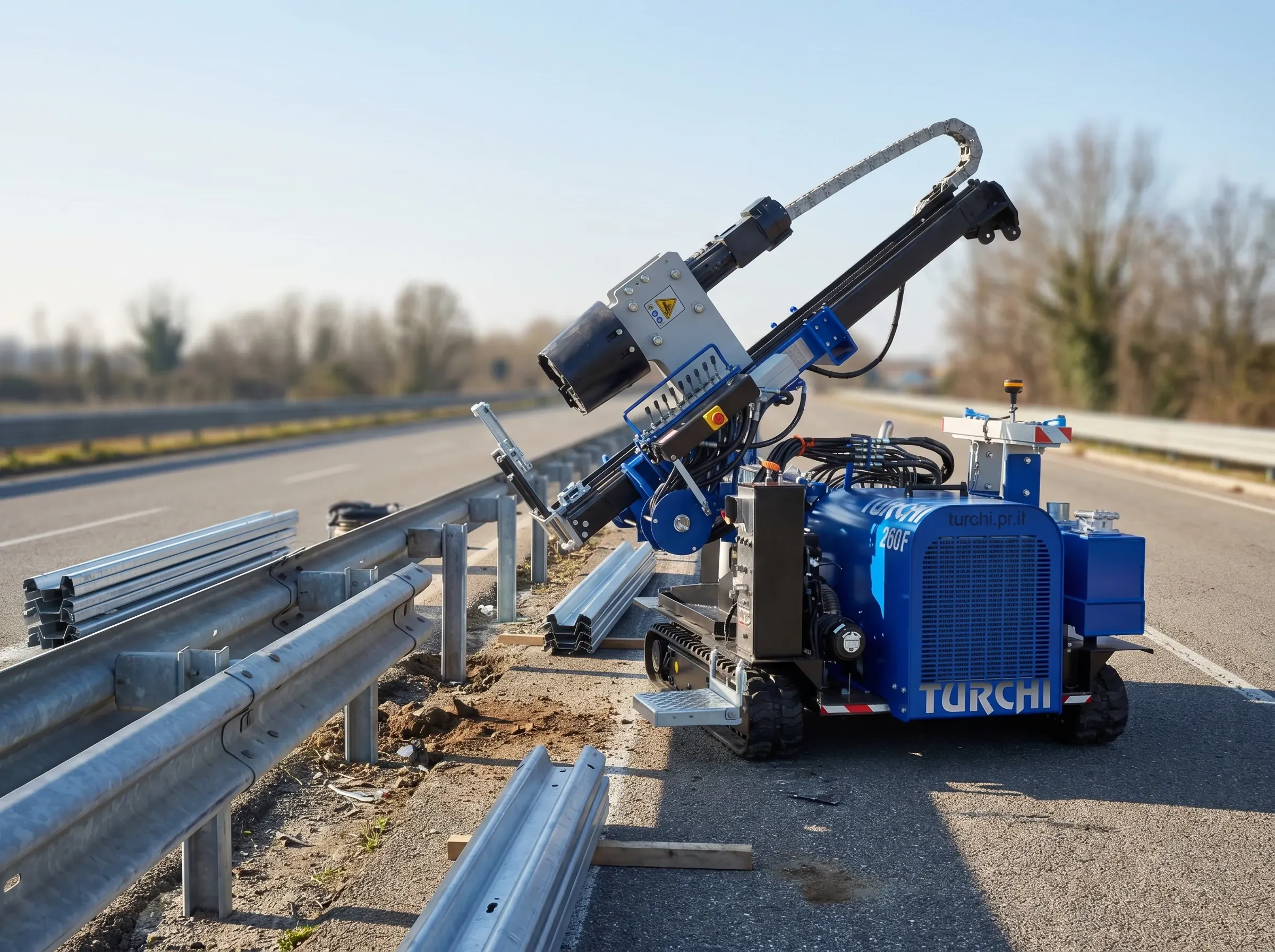
A modern pile driver such as the TURCHI 260F can be fitted with optional accessories that help meet these parameters: electronic verticality assistance, semi-automatic GPS for exact positioning and radio remote control. These technologies support conformity to the installed system, increase productivity and reduce errors, which on a road site can cause costly and potentially dangerous rework.
To find the configuration suited to your road sites, use the 7-step configurator and ask for a demonstration. For more on machine choice, read the solar pile driver buying guide.
Frequently asked questions
Can't find what you're looking for? Browse the full FAQ list. Reach out via a support request or email us at [email protected].
The European reference standard is EN 1317, adopted in Italy and mandatory for all CE-marked road restraint systems. Specific ministerial decrees also apply in Italy.
Containment classes (N1, N2, H1-H4b) define the barrier's ability to stop vehicles of different masses and speeds. They are determined by crash tests with real vehicles.
Yes: pile position, depth and verticality must follow the project and the restraint system's instructions. Semi-automatic GPS and assisted verticality are options that help the operator, but they do not by themselves certify the conformity of the installed barrier.
Yes, since 2011 all road restraint systems sold in Europe must carry CE marking compliant with EN 1317-5.